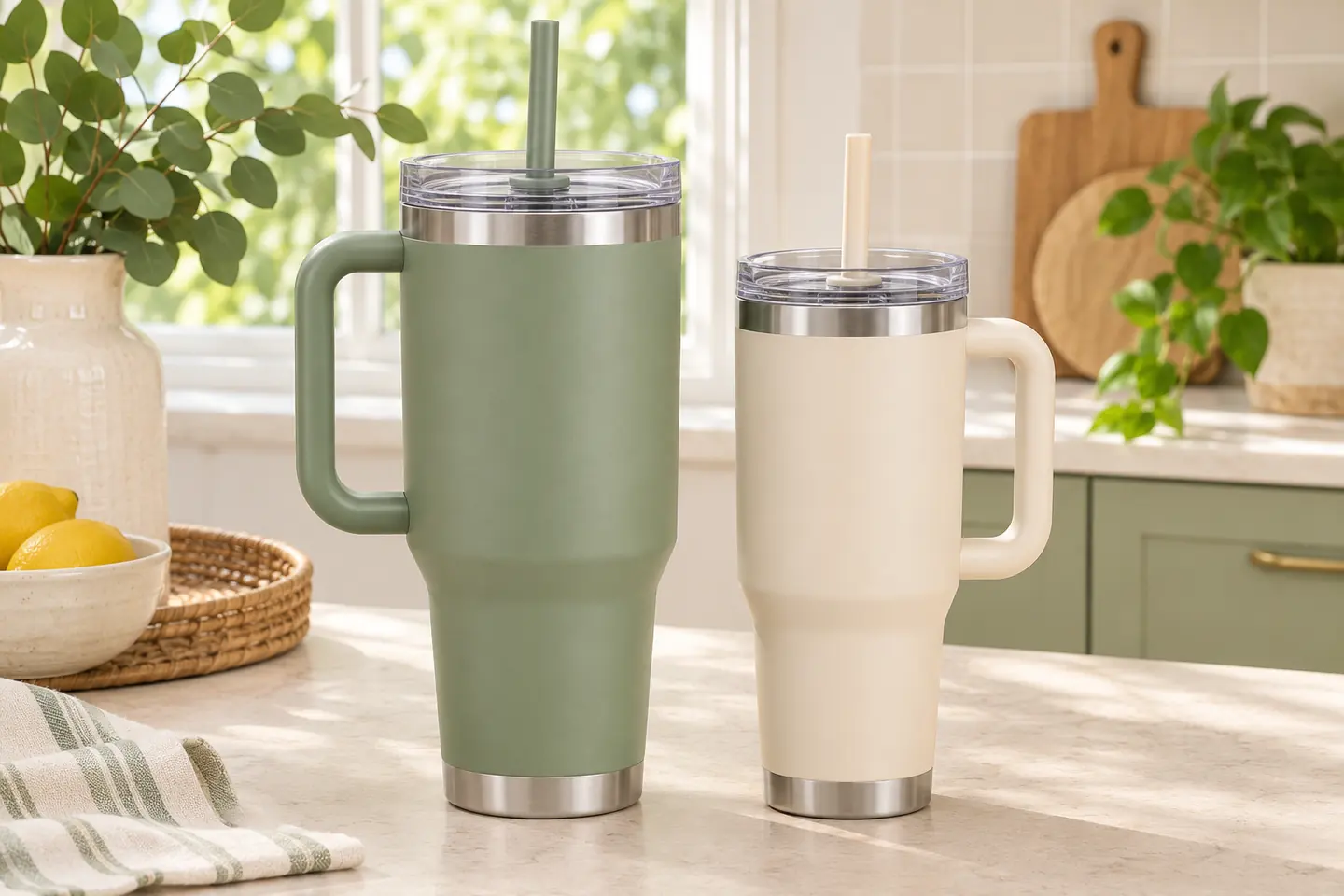
The Stanley Quencher H2.0 40 oz makes the most sense if you want a big cup of cold water within reach for hours and can keep it upright. It’s less compelling if you refill at a sink throughout the day, carry your drink far, or need to pack it beside a laptop. The 30-oz model gives up one small glass of water per fill and weighs about 12 ounces less when both cups are full.
Our pick for most people: the 30 oz. Buy the 40 oz if you regularly finish 30 fl oz before your next convenient refill and you have a place to set it down. Both sizes use Stanley’s FlowState straw lid, so choosing the smaller cup doesn’t solve spills in a bag.
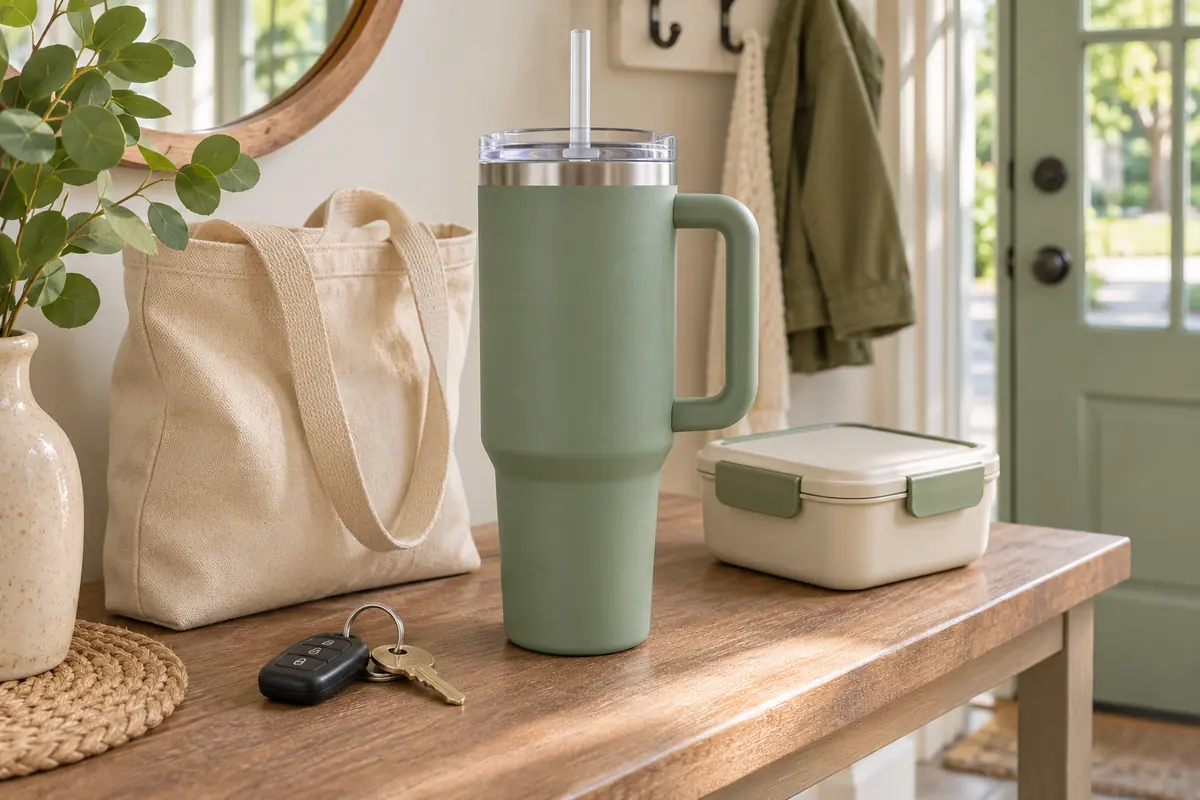
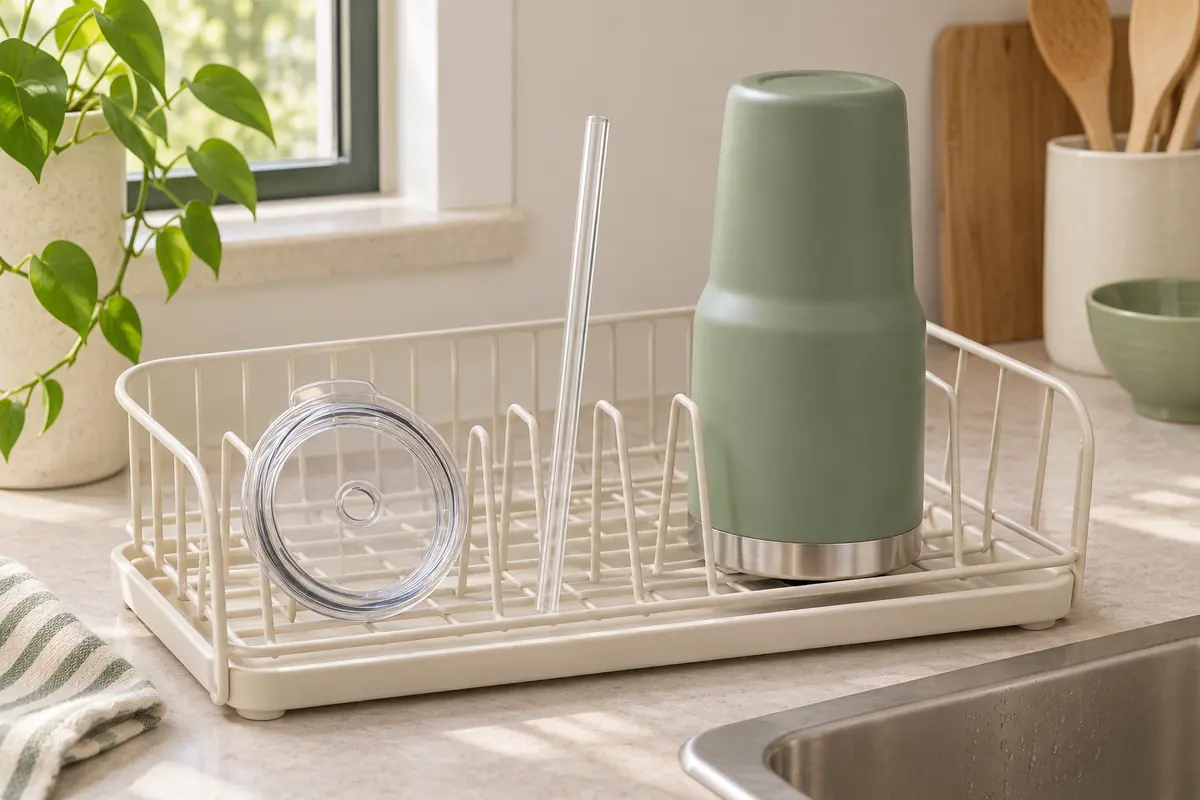
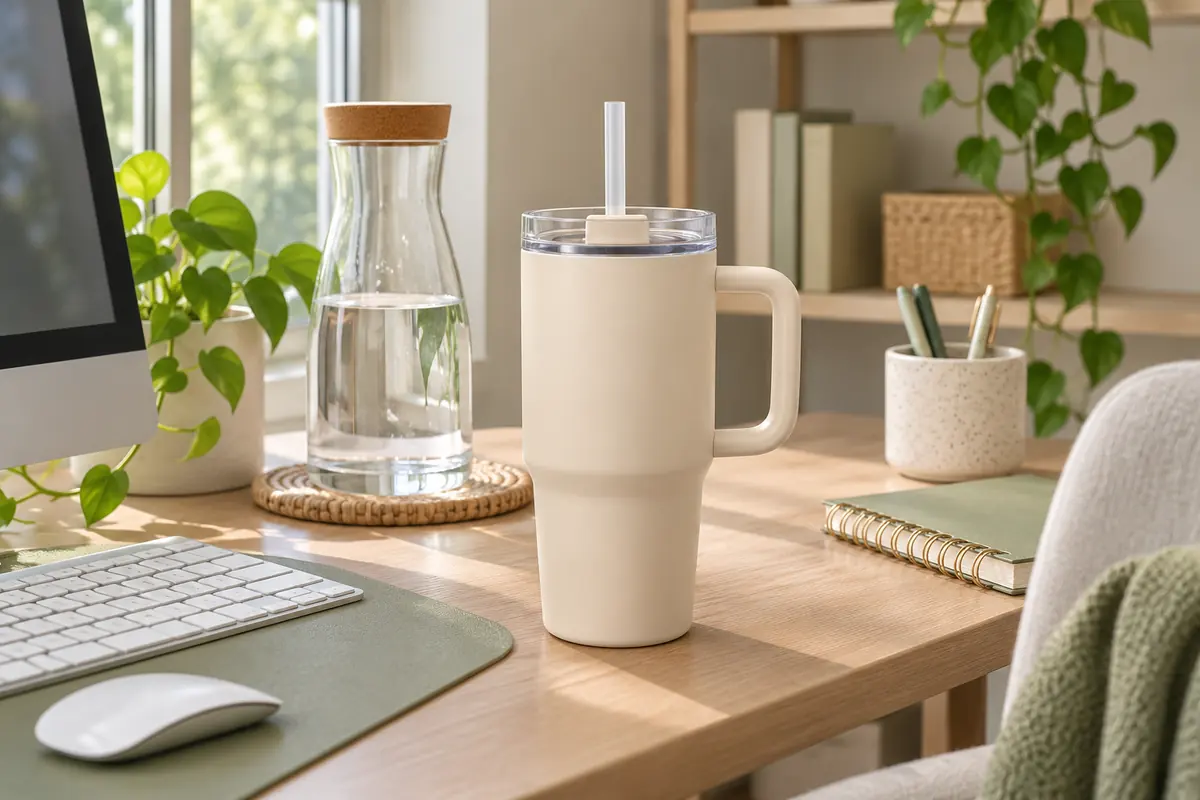
This buying guide uses manufacturer specifications and calculated full weights. The lifestyle images illustrate everyday use with generic tumblers.
Stanley Quencher H2.0 40 oz vs. 30 oz at a glance
| Feature | 40 oz FlowState | 30 oz FlowState |
|---|---|---|
| Capacity | 40 U.S. fl oz (1.25 qt; 1.18 L) | 30 U.S. fl oz (0.94 qt; 887 mL) |
| Stanley U.S. reference price | $45 for the Ash example | $35 for the Black 2.0 example |
| Listed empty weight | 1.18 lb (535 g) | 1.10 lb (499 g) |
| Estimated weight with water | 3.8 lb (1.72 kg) | 3.1 lb (1.39 kg) |
| Listed base diameter | 3.10 in (7.9 cm) | 3.15 in (8.0 cm) |
| Listed dimensions | 3.54 × 5.43 × 11.02 in | 3.46 × 5.40 × 10.80 in |
| Lid and cleaning | Three-position FlowState lid; dishwasher safe | Three-position FlowState lid; dishwasher safe |
| Best for | Long drives and long stretches between refills | Office days, shorter outings, and frequent refills |
Dimensions, weight, and U.S. reference prices come from Stanley’s 40-oz Ash listing and 30-oz Black 2.0 listing. Prices and availability vary by finish and seller. The two sizes have nearly identical listed base diameters and overall widths, so don’t assume the 30 oz will fit a narrower slot.
A quick way to decide: The extra 10 fl oz is 1¼ U.S. cups (about 296 mL). If that saves you a refill during a long drive or shift, the larger cup earns its space. If you already top up your drink every time you pass the kitchen, the upgrade mostly means carrying more weight.
How heavy is the 40-oz Stanley when full?
The 40-oz tumbler weighs about 3.8 lb (1.72 kg) filled to its nominal capacity with water. Water accounts for about 2.6 lb of that; the empty tumbler makes up the rest. The equivalent estimate for the 30 oz is 3.1 lb (1.39 kg). The difference is about 0.73 lb (12 oz; 330 g). That’s based on the listed empty weights and water volume, rather than a scale test. Ice, headspace, and the type of drink change the actual result.
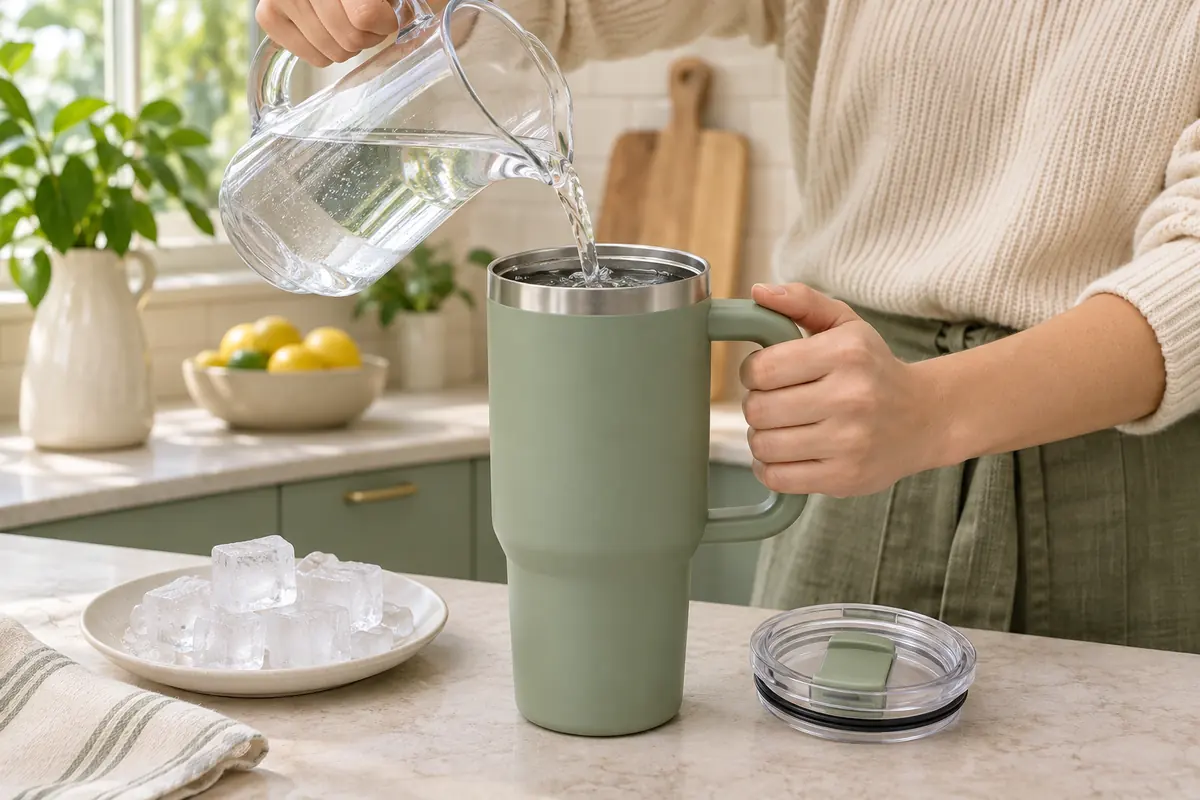
That extra weight is easy to live with when the cup spends most of the day on a desk. You’ll notice it more when you’re carrying it from a distant parking spot or lifting it repeatedly with one hand. The handle gives you a place to grip; it doesn’t make the water any lighter. If you occasionally want extra capacity, you can buy the 40 and fill it only partway on lighter days. You still carry the larger cup and handle.
Does the Stanley 40 oz fit in a car cup holder?
The 40 oz has a tapered base listed at 3.1 inches (7.9 cm). It can fit many conventional round center-console holders, but a matching diameter at the rim of your holder doesn’t guarantee a stable fit. A deep recess, a narrow bottom, or the side handle may get in the way. Stanley lists the 30-oz example at 3.15 inches (8.0 cm) at the base, so treat it as a lighter alternative rather than a fix for a tight holder.
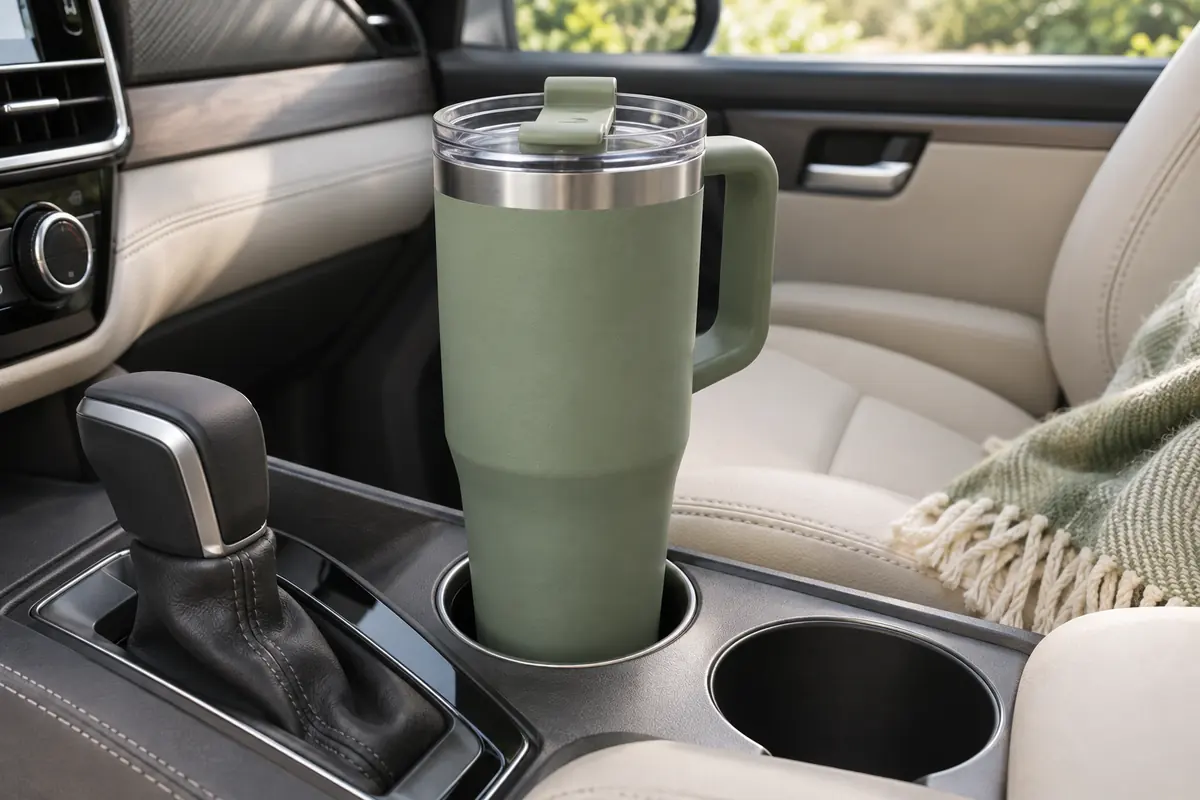
- Measure inside the holder at the depth the cup will sit. Check for rubber tabs or a step that narrows the opening. If your measurement barely matches the base, try the cup in person or buy from a seller with an easy return policy.
- Check handle clearance with the car parked. Rotate the handle so it doesn’t interfere with the gear selector, console controls, armrest, or the cup next to it.
- Check both height and stability. The straw needs room below the dashboard, and the bottom should seat securely without rocking. A cup that fits into a shallow holder can still tip when you turn.
Will the FlowState lid spill?
It’s splash-resistant, not leakproof. The cover rotates between an opening for the straw, a drink opening, and a covered position. The straw seal helps limit splashes around the straw, but liquid can still escape through the straw itself when the cup tips. Pulling out the straw and rotating to the covered position can reduce splashing when you carry the cup upright. Stanley describes that position as resisting splashes, so don’t count on it to seal a tumbler lying sideways in a tote.
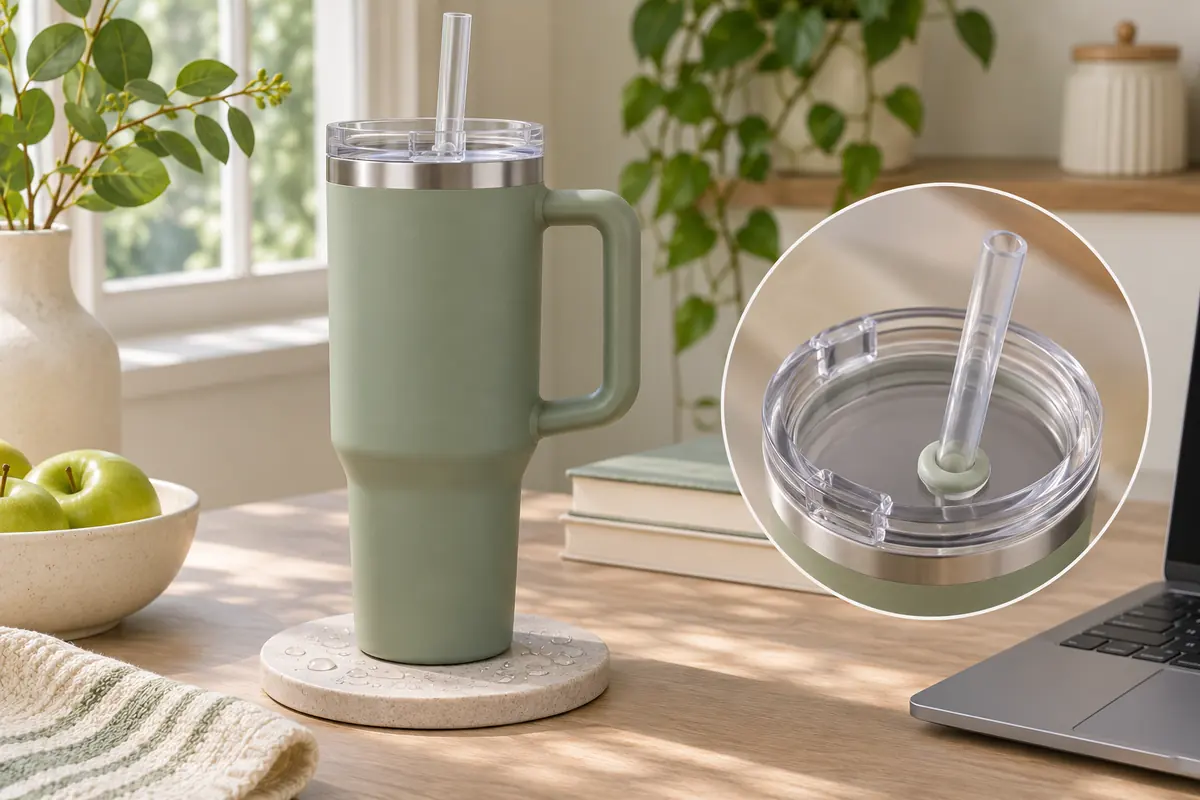
If you want a straw but need to carry your drink in a bag, compare the Stanley Quencher ProTour. Stanley advertises the ProTour’s flip-straw lid as leakproof when closed. It is a different Quencher version. Check the listing for the lid type instead of shopping by the word “Quencher” alone.
How easy are the straw and lid to clean?
Both FlowState listings say the tumbler is dishwasher safe. The straight straw is easy to reach with a narrow brush. The lid takes a little more attention: the underside, threads, and areas around the rotating cover are easy to miss if you only rinse the top. That’s especially noticeable after coffee with cream, a sweetened iced tea, or a powdered drink mix dries in the openings.
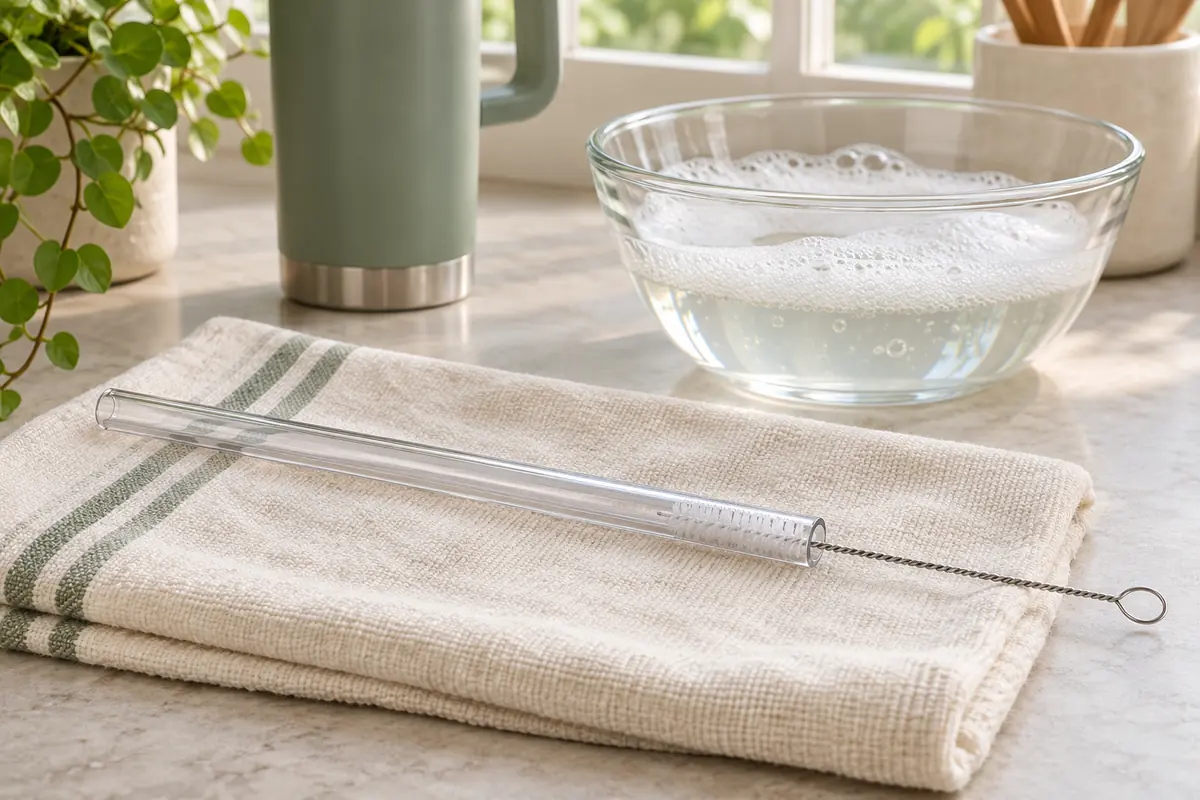
- Take the cup apart for washing. Pull out the straw and unscrew the lid. Use warm water and dish soap on the cup and lid, or follow the dishwasher instructions for your unit. Stanley’s U.S. care FAQ recommends the top rack for dishwasher-safe products. A tall tumbler can be simpler to hand-wash if it won’t fit.
- Brush through the straw. Run warm, soapy water through it and use a straw brush long enough to reach the middle from either end. Rinse thoroughly.
- Wash the underside of the lid. Rotate the cover so you can clean each opening and the area around it. If your exact lid’s care instructions show how to remove the slider or seals, follow those directions. Avoid forcing anything that doesn’t release as described.
- Air-dry everything separately. Leave the lid off until all the parts are dry, especially if you’re putting the cup away.
Is the Stanley Quencher H2.0 40 oz worth it?
Choose 40 oz if refills interrupt your day and you can keep the cup upright at a desk or in a holder you’ve checked. At the reference prices, the extra 10 fl oz costs $10. If you refill throughout the day, prefer a lighter carry, or rarely finish a 30-oz drink in one stretch, choose 30 oz. If your main concern is leakage in a bag, choose a cup with a lid specifically designed to seal when closed.
For U.S. shoppers, these are the exact variants and listing identifiers used in this guide. A retailer’s item number may differ from Stanley’s shop SKU.
- 40 oz H2.0 FlowState, Ash: item number 10-10824-603 (Stanley U.S. shop SKU 100000104047); $45 reference price. See the 40 oz at Stanley U.S.
- 30 oz H2.0 FlowState, Black 2.0: Stanley SKU 10-10827-200; $35 reference price. See the 30 oz at Stanley U.S.
- 40 oz H2.0 FlowState, Black 2.0: Amazon U.S. listing identifier B0CP9Z1S51. Check the 40 oz Black 2.0 on Amazon. Confirm the selected size, lid type, seller, price, and returns before ordering.
You can also check Target’s FlowState listings if you want to see which colors or sizes are available for local pickup.
Frequently asked questions
How much more water does the 40 oz hold?
It holds 10 U.S. fl oz more than the 30 oz, or 1¼ cups (about 296 mL). That’s a one-third increase in capacity.
Can I put a full Stanley Quencher on its side?
Don’t do that with the H2.0 FlowState lid. Keep it upright even with the rotating cover in the covered position. If you regularly need to pack a cup sideways, look for an explicitly leakproof design and follow its closure instructions.
Do the 30-oz and 40-oz versions use the same straw?
Don’t assume they do. When ordering a replacement, match your capacity and lid family. Look for the size on the product or in your order details, especially if you’re choosing between FlowState and ProTour accessories.
Kitchen conditions and products vary. Follow manufacturer guidance and consult a qualified professional when safety or specialist work is involved.