Documentation checked October 18, 2026 • U.S. models and USD prices • Research-based guide
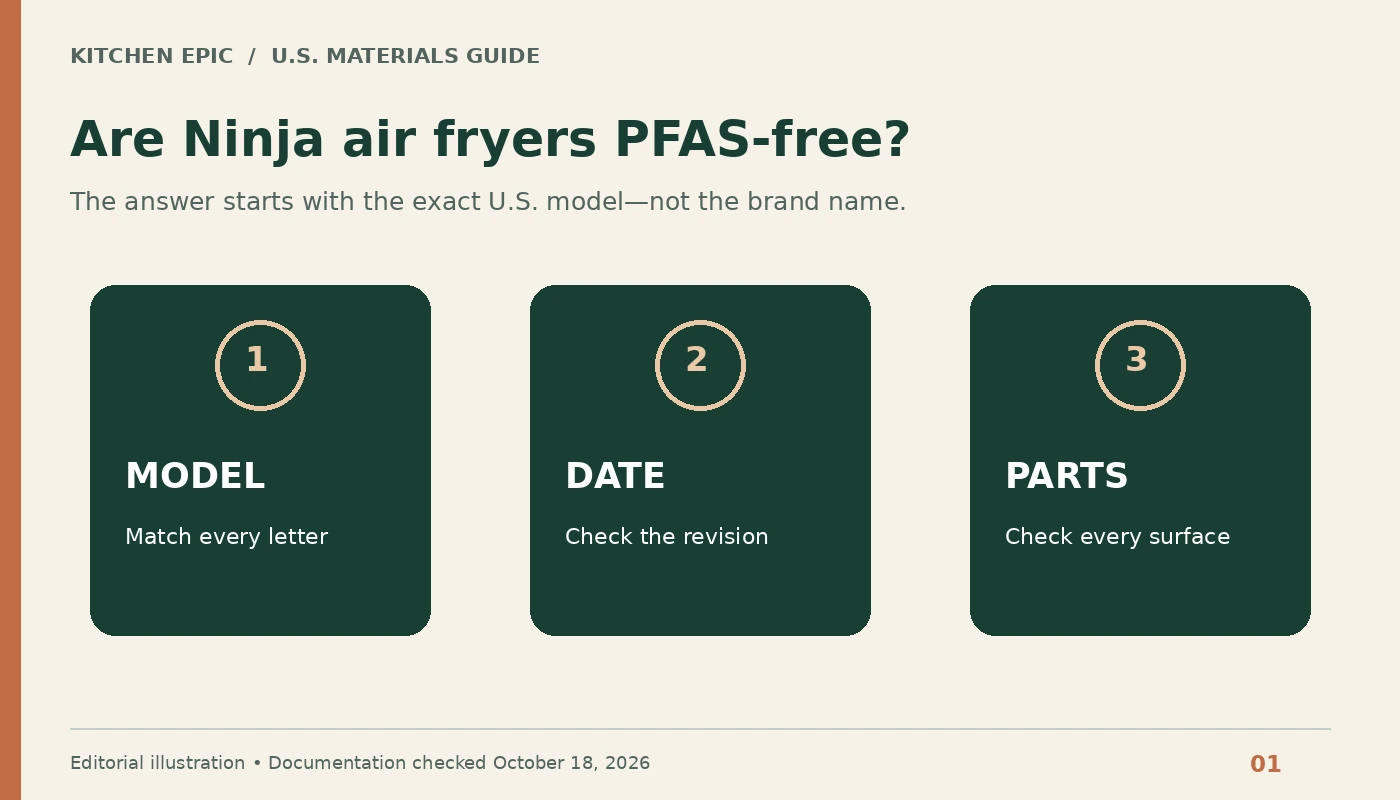
Some Ninja air fryers have explicit PFAS-free cooking-surface claims, but you should not apply that answer to the entire brand. Ninja’s current U.S. Crispi comparison identifies PFAS- and PTFE-free cooking surfaces for FN101ST, AS101LG, and DD101GN2. For conventional basket models, check the production or purchase period and obtain a component-specific answer. A “nonstick,” “ceramic,” or “PFOA-free” description alone is insufficient.
Those Crispi statements are manufacturer claims, not independent laboratory results from Kitchen Epic. They also should not be expanded into a claim that every internal component of the appliance contains zero PFAS.
If you have seen conflicting answers about Ninja baskets, you are not imagining the problem. Product pages, replacement-part listings, and older chemical disclosures can describe different things. This guide shows how to compare them without turning uncertainty into either a blanket safety guarantee or an alarmist warning.
For broader shopping comparisons, see our glass air fryer guide and air fryer materials and alternatives guide. Here, the focus is verifying your Ninja.
What PFAS-free, PTFE-free, and PFOA-free actually tell you
PFAS is a large chemical family. PTFE is a fluoropolymer within that family; PFOA is a different, individual PFAS. A claim about one does not answer every question about the other. The EPA explains that there are thousands of PFAS and that their persistence and potential effects require careful assessment.
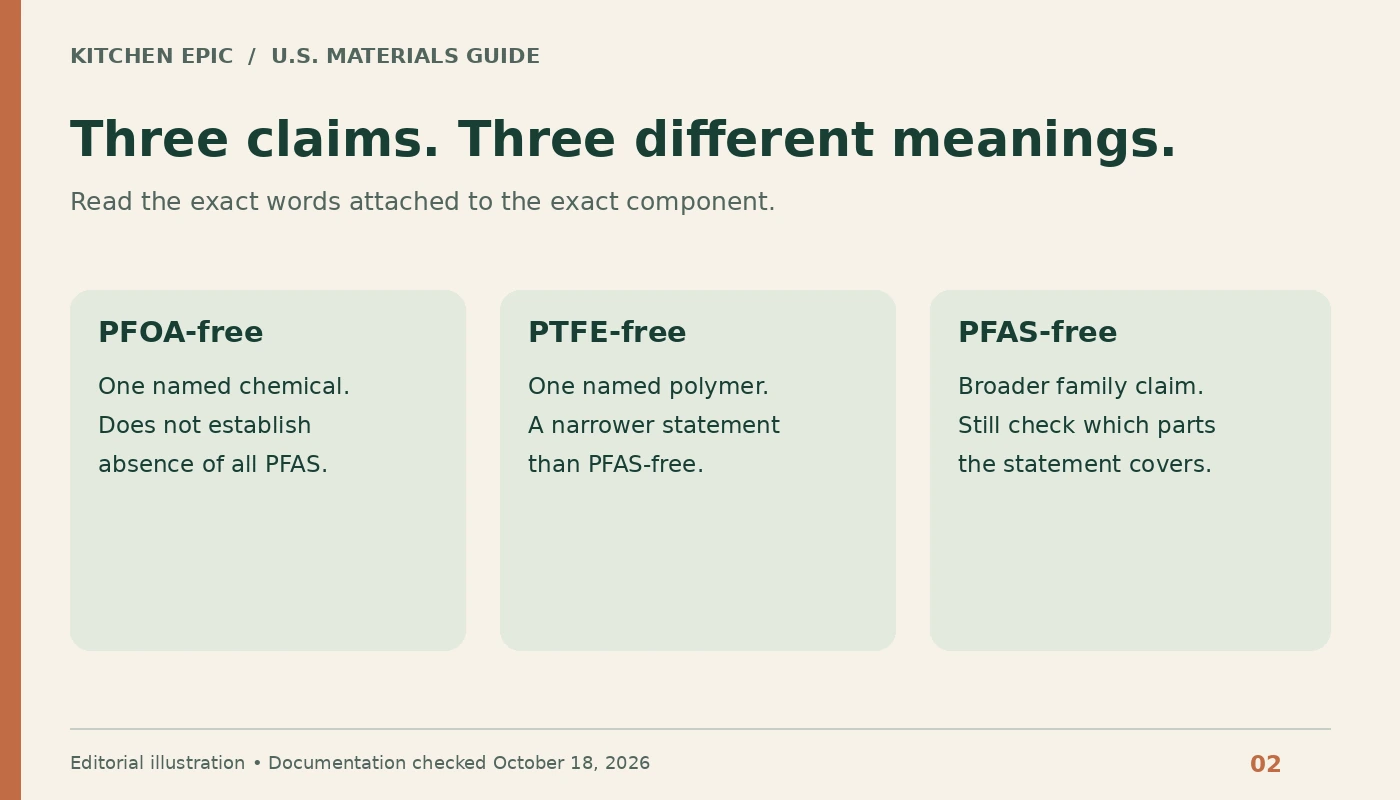
- PFOA-free: answers a question about PFOA. It does not establish that a coating is PTFE-free.
- PTFE-free: excludes a named fluoropolymer; it is narrower than a claim about all PFAS.
- PFAS-free: is the broader statement to look for if avoiding PFAS is your goal. Confirm whether it means no intentionally added PFAS, a testing threshold, or another defined standard.
- Ceramic-coated or nonstick: describes a surface or performance characteristic. Ask for a separate chemical declaration.
- BPA-free: concerns a different chemical and does not answer the PFAS question.
These distinctions are useful when comparing retailer listings. A product title may emphasize the glass container while the food actually rests on an included crisper plate. Read beyond the headline.
Exact U.S. Ninja models: what the documentation supports
The table separates explicit cooking-surface statements from date-dependent disclosure evidence. Prices are snapshots from SharkNinja’s U.S. store on October 18, 2026, before tax and shipping; promotions and availability can change. They are not a ranking of cooking performance.
| Exact U.S. model | Capacity and observed price | Evidence and practical conclusion |
|---|---|---|
| Crispi FN101ST Stone | 4 qt + 6 cups $152.99 sale; $179.99 reference price | Ninja’s comparison explicitly marks the cooking surfaces PFAS- and PTFE-free. Keep the scope at cooking surfaces; verify separately purchased accessories. |
| Crispi Pro AS101LG Bone | 6 qt + 2.5 qt $299.99 | Explicit PFAS- and PTFE-free cooking-surface statement in the manufacturer’s comparison. Included glassware and crisper plates are identified on the product page. |
| Crispi DualZone DD101GN2 Vista Green | Two 4-qt containers; 8 qt total $379.99 | Explicit cooking-surface statement in Ninja’s comparison, plus PFAS/PTFE-free glassware wording. Do not transfer this to every product named DualZone. |
| Air Fryer Pro AF141 | 5 qt $129.99 | Date-dependent AF140/AF14X disclosure evidence. Current main product description says nonstick. Ask for confirmation covering your basket and plate. |
| Air Fryer Pro XL AF181 | 6.5 qt $119.99 sale; $179.99 reference price | Date-dependent AF180/AF18X disclosure evidence. Nonstick wording alone does not establish a complete PFAS-free claim. |
Source: linked manufacturer product pages and the current Ninja chemical disclosure. Exact-model-to-series matching is our reading of Ninja’s SKU groupings; have Ninja confirm unusual suffixes or uncertain production codes.
Already own an AF101? Do not use a new replacement plate’s description to identify the original basket. The model’s original components and any later replacements need separate checks. The part example below shows why.
Why the date on Ninja’s disclosure matters
The PDF linked from Ninja’s current U.S. product-page footer is marked last updated October 6, 2026, despite “102025” in its filename. Page 11 covers products manufactured before August 15, 2024 and lists PTFE for several air fryer series. Page 12 covers products manufactured after August 15, 2024 or purchased after January 1, 2025; it includes AF14X and AF18X without listing PTFE. This is a disclosure change, not a published zero-PFAS laboratory certificate.
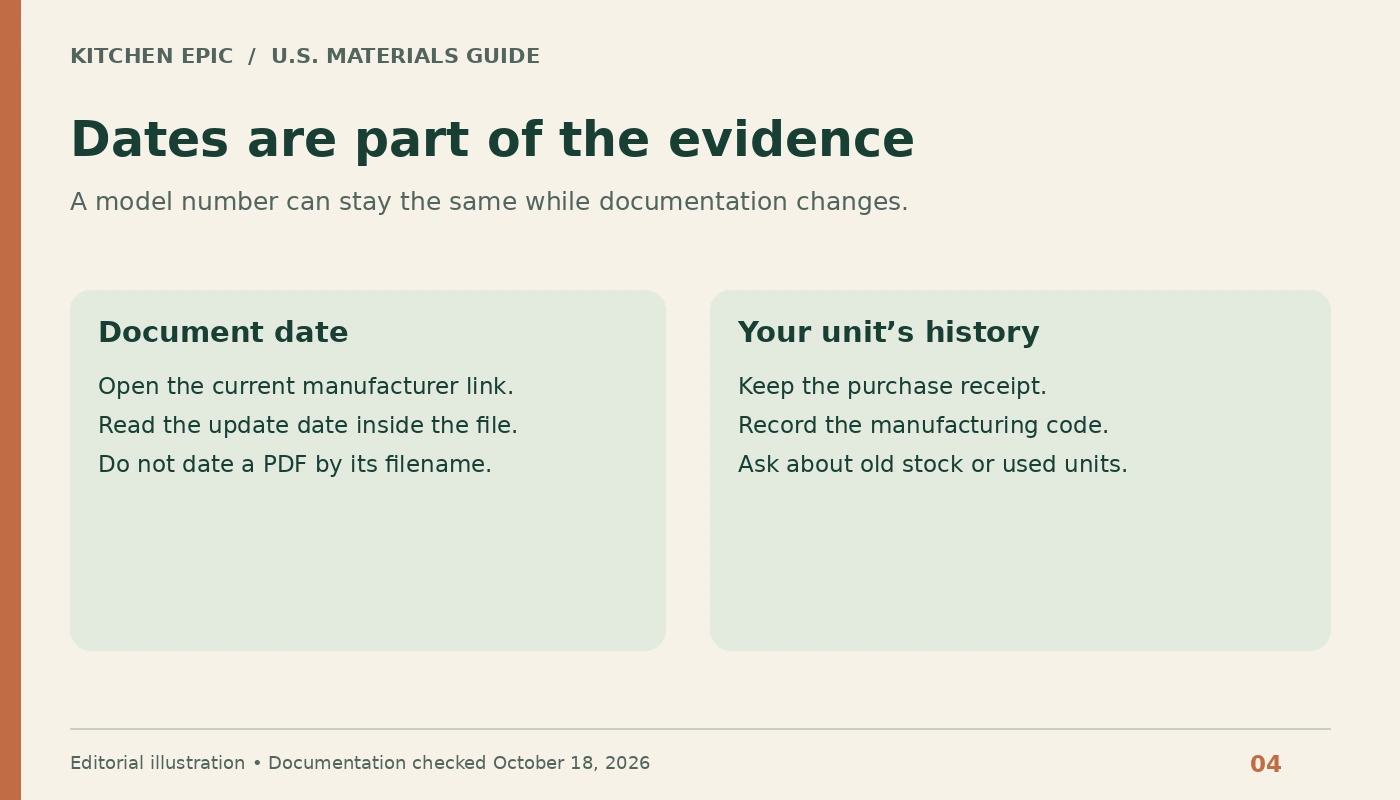
For a used appliance, refurbished unit, older replacement basket, or purchase on a boundary date, ask Ninja to resolve the applicability. Do not assume a recent marketplace receipt answers the manufacturing-history question.
California’s cookware disclosure guidance explains that the rules concern listed chemicals intentionally added to food-contact surfaces or handles. A disclosure list is therefore not a comprehensive recipe for every material in an appliance. Nor does a chemical’s appearance on a list, by itself, quantify how much reaches your meal.
Check the basket, crisper plate, and accessories separately
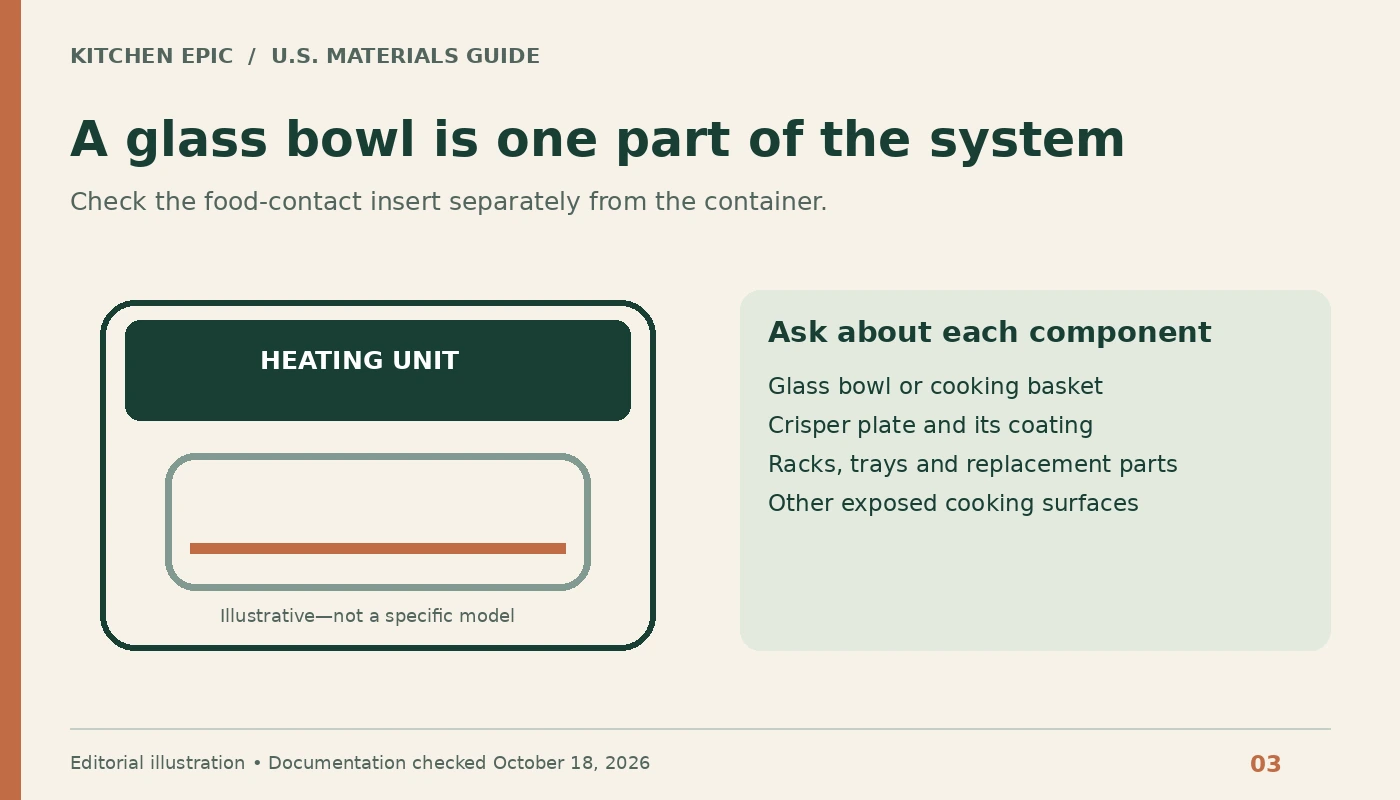
A removable insert can have a different finish from the surrounding basket. The same is true of roasting racks, baking pans, and third-party accessories. “Glass air fryer” is a useful description of a container, but it does not identify every surface that participates in cooking.
For example, Ninja’s 103KY100 replacement crisper plate is described as ceramic-coated and free of PTFE and PFOA. Its compatibility list includes AF101, and the observed price is $18.99. That statement supports a conclusion about this replacement plate. It does not retroactively establish the formulation of an older plate or make an AF101 basket PFAS-free.
If your requirement includes every exposed surface in the heated chamber, state that explicitly when contacting the company. A reply limited to the basket should not be expanded to cover the heating assembly, seals, racks, or other components.
How to check your Ninja air fryer in five steps
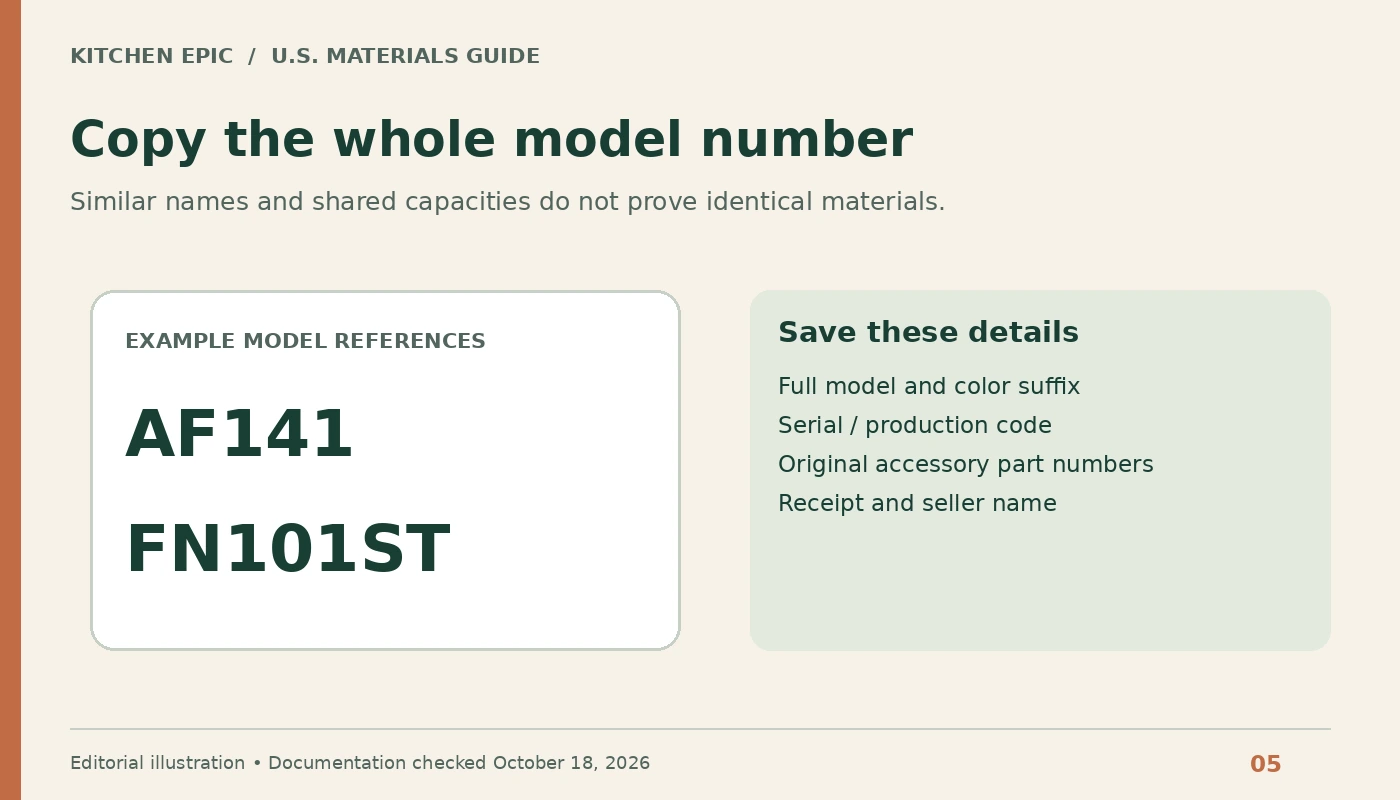
- Identify the exact unit. With the appliance unplugged and cool, find its rating label as directed by the manual. Record the full model and any serial or production code. Also keep the box label and receipt when available.
- Use the U.S. documentation. Match the full code to the product page and owner’s guide. Do not substitute a UK, European, Canadian, or Australian model because its name or appearance is similar.
- Follow the current disclosure link. On the manufacturer’s U.S. site, look for California AB1200 information. Read the revision inside the PDF and the heading above the relevant model group.
- Read claims at component level. Save the exact statement for the container, basket, plate, and any extra accessory. Distinguish manufacturer text from customer answers and review comments.
- Resolve gaps in writing. Ask Ninja about the exact unit and parts. Save its reply with the date and support case number, especially before the retailer’s return window closes.
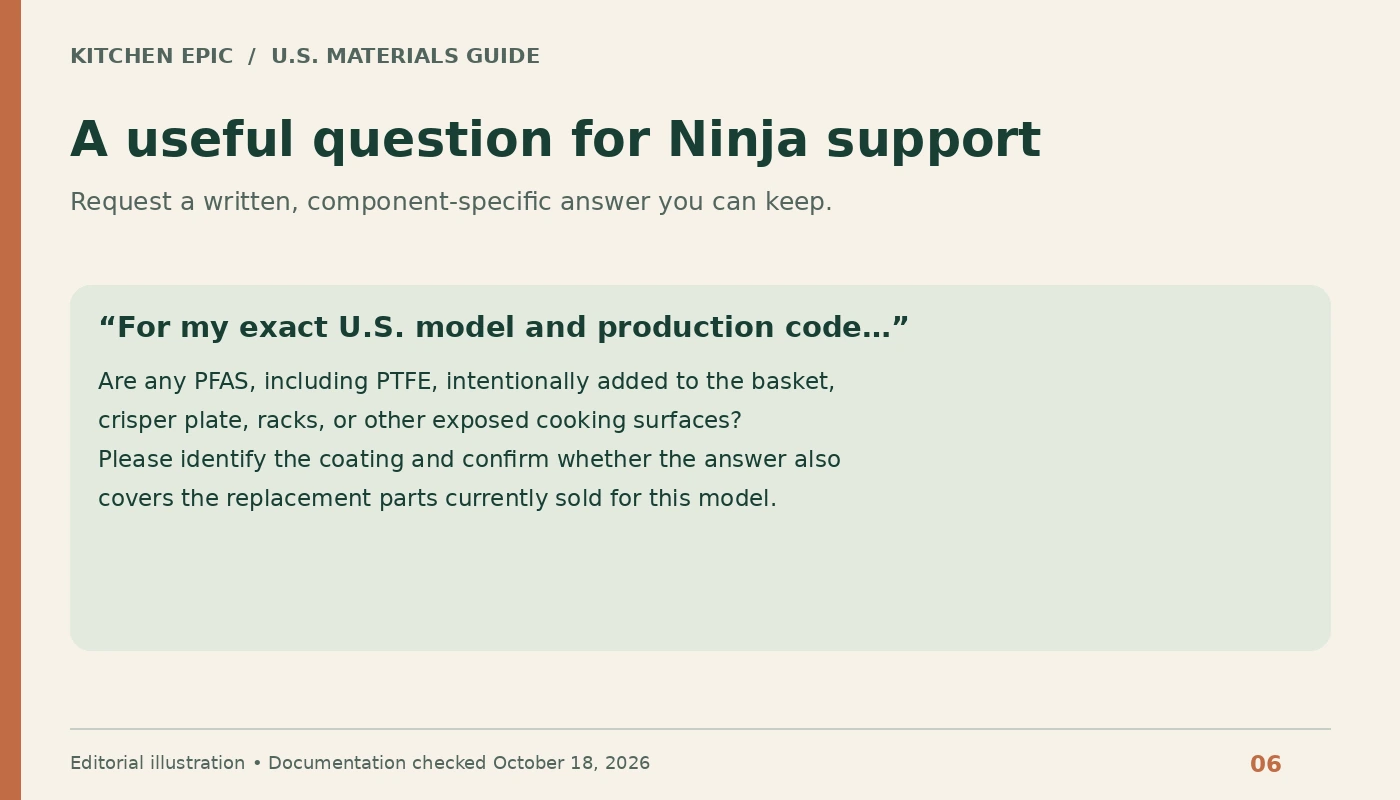
A message you can copy to customer support
My U.S. Ninja model is [full model], with production code [code], purchased from [retailer] on [date]. Are any PFAS, including PTFE, intentionally added to the basket, crisper plate, racks, or other exposed cooking surfaces? Please identify which components your answer covers, the coating type, and whether the same answer applies to the replacement parts currently sold for this model. If testing supports the claim, please provide its scope and detection limit.
Use Ninja’s official support channel linked from the product page. Do not post your receipt, address, or full serial number in public product reviews just to obtain a materials answer.
Practical U.S. shopping questions beyond the coating
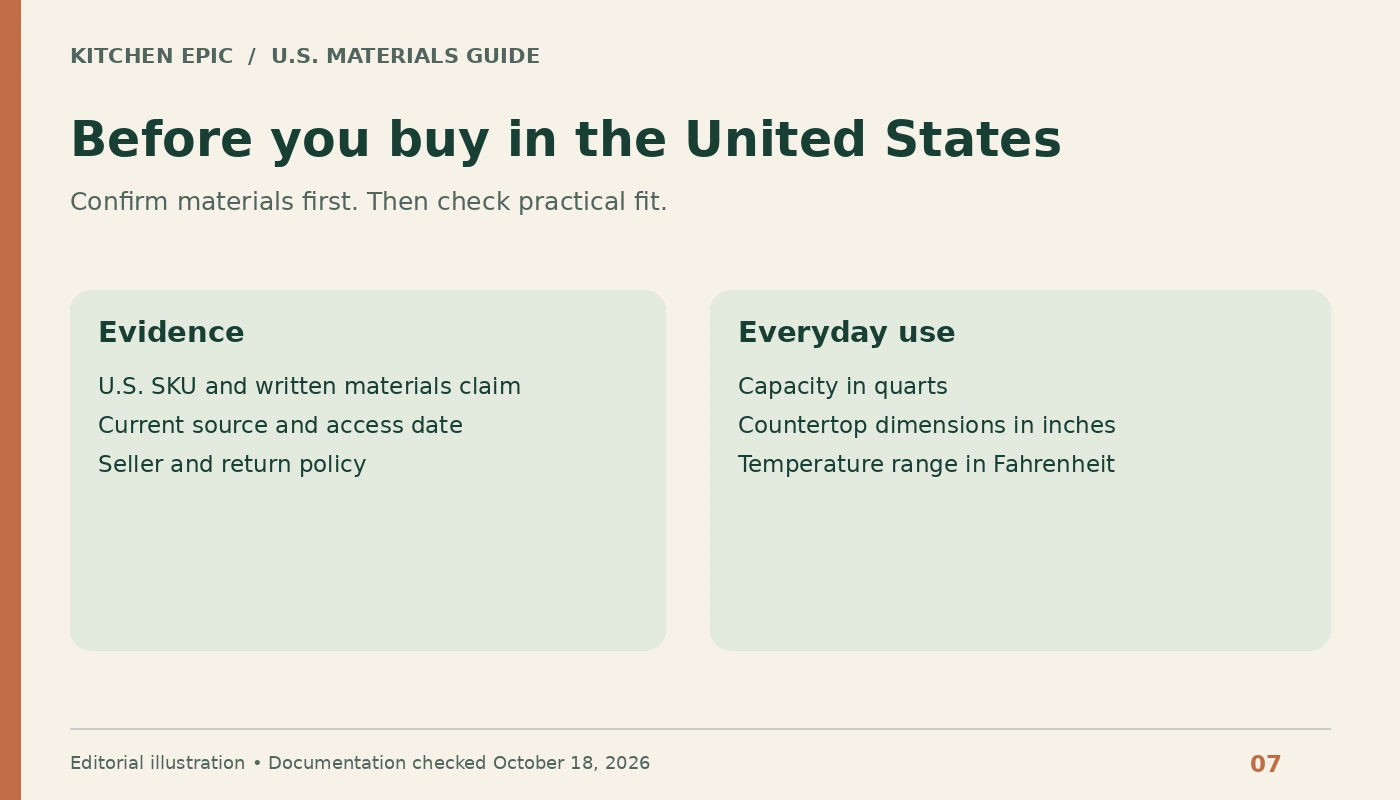
Where should I check? Start with SharkNinja’s U.S. store and compare the exact SKU at U.S. retailers. For example, Target lists FN101ST. Match the model in the specifications, not just the image. On marketplaces, distinguish the seller from the platform and check whether the item is new, used, or refurbished.
Will it fit? Ninja lists AF141 at 14.84 × 11.34 × 10.55 inches (L × W × H). FN101ST is listed at 11.5 × 9.76 × 11.81 inches. Those are appliance dimensions, not ventilation clearances. Leave the space required by the model’s manual and allow room to remove the container safely.
How much capacity do I need? Five U.S. liquid quarts are about 4.7 liters; 6.5 quarts are about 6.2 liters. Total volume does not tell you how much food fits in one uncrowded layer. Two 4-quart containers also behave differently from one large cooking chamber when preparing a single bulky item.
Does a higher temperature prove anything about PFAS? No. AF141 advertises up to 400°F (about 204°C), while AF181 and the listed Crispi models reach up to 450°F (about 232°C), depending on model and mode. An advertised heat setting is an operating specification, not a chemical test. Follow the instructions for the particular appliance.
If your older air fryer contains PTFE, is it automatically unsafe?
No. Material identity and exposure are different questions. The FDA’s explanation of authorized food-contact uses says polymerized nonstick coatings on pots and pans are tightly bound and that studies show negligible migration from those coatings into food. That general explanation is not a test of your particular Ninja, and it is not a statement that all PFAS exposures are harmless.
If your shopping preference is to avoid intentionally added PFAS, you can apply that preference without asserting that a particular appliance causes disease. Do not interpret “PFAS-free” as a guarantee against every cooking hazard, either: hot surfaces, steam, damaged components, and misuse still matter.
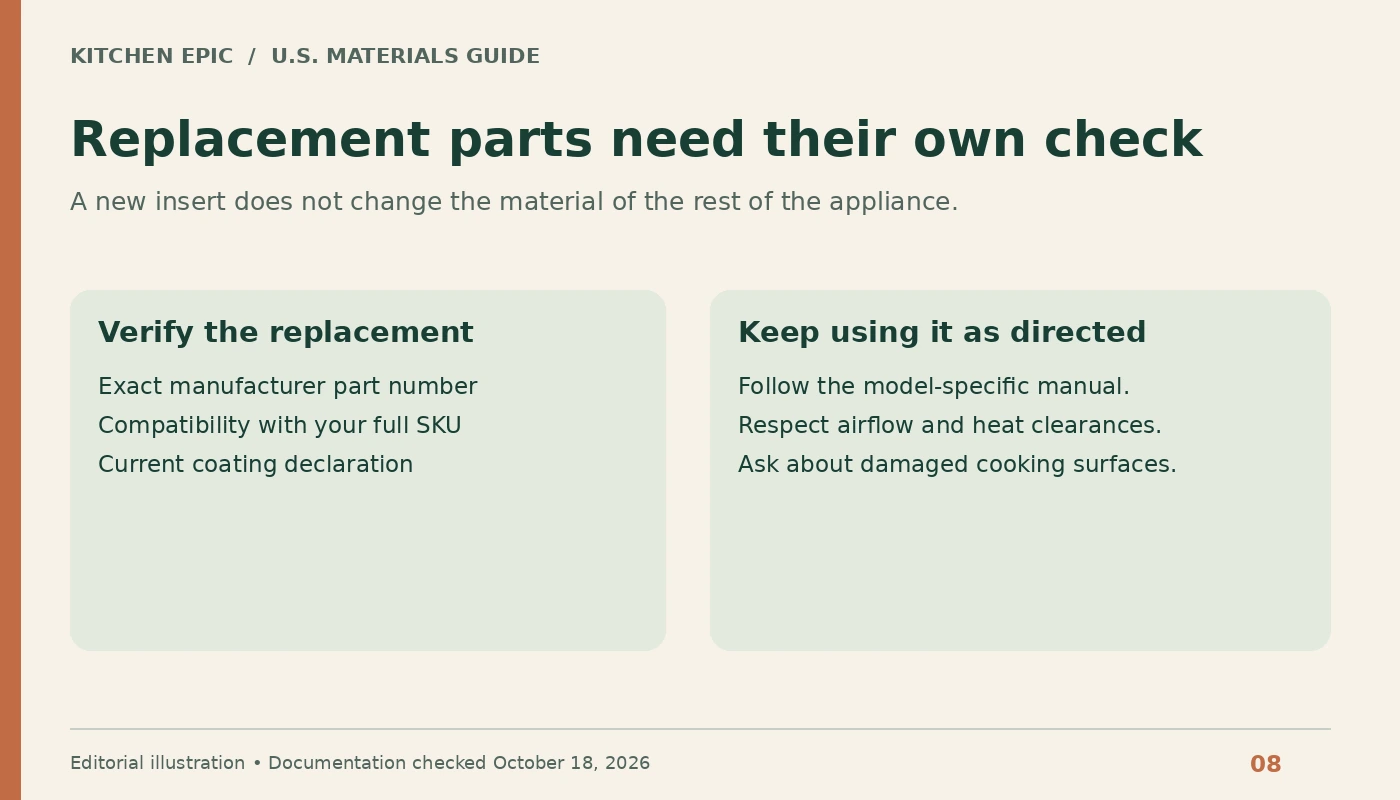
Follow the manual’s cleaning and preheating directions. Use the recommended utensils and cleaners, preserve ventilation and airflow, and ask the manufacturer about peeling, flaking, or otherwise damaged food-contact surfaces. Do not sand or strip a coating to create a homemade “PFAS-free” basket, and do not use liners as proof that the underlying appliance has changed materials.
Frequently asked questions
Are all Ninja air fryers PFAS-free now?
Do not make that assumption. Use the model-specific evidence above and ask about the components that matter to you. A new product in one family does not establish the materials in every Ninja appliance.
Is Ninja Crispi PFAS-free?
The specific U.S. Crispi models in the table have explicit manufacturer cooking-surface claims. Keep the distinction between a documented claim and independent testing, and recheck replacement accessories.
Does “ceramic-coated” mean there is no PTFE?
The word alone does not settle the question. Look for a separate, explicit declaration for the exact component. A coating’s color, texture, or food-release performance cannot verify its chemistry.
Can a new crisper plate make my old air fryer PFAS-free?
A replacement changes only that component. The basket and other exposed surfaces retain their own materials. Confirm compatibility as well as the replacement’s declaration.
What if two Ninja sources disagree?
Save both links and their dates. Check whether they describe different production periods, regions, or parts, then ask Ninja to reconcile the statements for your unit. Until then, label the answer unconfirmed rather than selecting the more reassuring wording.
Our buying advice
If documented PFAS avoidance is a priority, favor an explicit statement covering the cooking surfaces you will actually use. Keep the full model number, source date, and any written support reply together. When the evidence is incomplete, resolve it before buying—or choose a product whose materials are documented more clearly.
How we researched this guide: We compared current U.S. manufacturer product pages, the disclosure linked from Ninja’s U.S. site, replacement-part descriptions, and FDA, EPA, and California DTSC explanations. We did not perform laboratory testing or hands-on cooking tests for this article. The eight graphics are original editorial illustrations. Manufacturer pages can change; source links are provided beside the relevant statements. See our editorial policy.
Kitchen conditions and products vary. Follow manufacturer guidance and consult a qualified professional when safety or specialist work is involved.