Shopping for titanium vs stainless steel cookware becomes much easier once you ask one question: what is the pan actually made of? “Titanium” can describe a lightweight metal pot, an ingredient in a nonstick coating, or a surface bonded to stainless steel. Those are different products with different strengths.
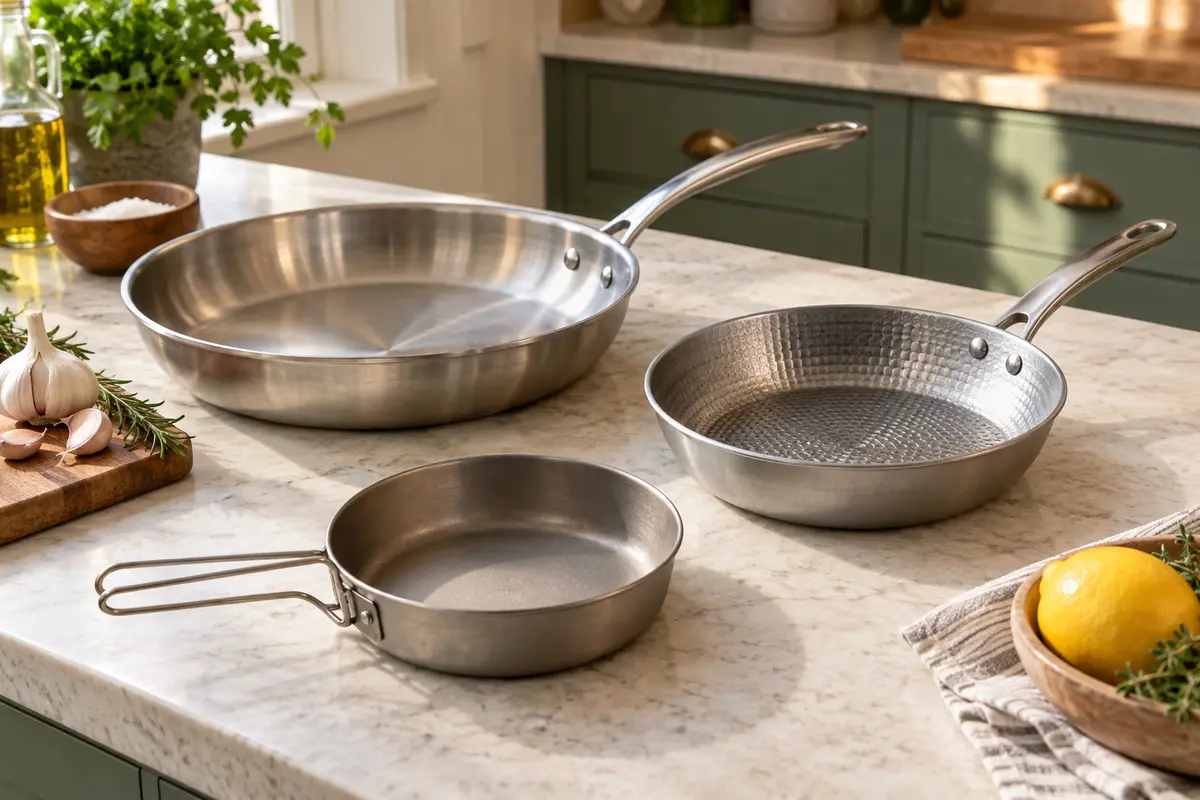
Research disclosure: This is a research-based comparison, not a hands-on cookware test. We reviewed manufacturer specifications, material disclosures, and care guidance on October 13, 2026. Product examples illustrate construction differences; they are not test winners. The seven images, including the featured image, are illustrative cookware visuals from our media library. They do not document testing or establish the materials or performance of any named product.
What does “titanium cookware” mean?
1. Solid titanium cookware
Here, the vessel itself is titanium rather than an aluminum pan with a titanium-branded coating. Many familiar examples are compact camping pots with thin walls and folding handles. Their appeal is portability, not the promise of an effortless omelet.
Snow Peak explains that titanium is not a strong heat conductor and is better suited to heating liquids and noodle soups than more demanding cooking. That makes a lightweight pot useful for boiling water on a trip, but a poor basis for claiming that all titanium pans distribute heat exceptionally well.
Do not assume that a titanium-colored home skillet has this construction. Some products use a titanium cooking surface over other metals. If the label describes a composite body, investigate its layers instead of applying conclusions about thin camping pots.

2. Titanium-reinforced nonstick cookware
In this category, titanium refers to reinforcement in a nonstick system. The pan underneath may be aluminum, and the coating may contain PTFE—the polymer responsible for food release in many traditional nonstick pans.
For example, T-fal describes its Ultimate Hard Anodized set, model H927SA64, as having a titanium nonstick coating and explicitly discloses PTFE. Its separate materials disclosure also identifies PTFE in relevant nonstick collections.
The useful buying question is therefore “What is the coating, and how must I care for it?” A tougher-sounding reinforcement name does not make the coating permanent or remove its temperature limits.
3. Titanium-bonded stainless steel
This is where the comparison overlaps. Hestan NanoBond uses titanium-based surface technology on clad stainless steel. Hestan explicitly says NanoBond is not a nonstick coating.
Think of it as a particular stainless steel cookware system with a treated surface, not as a camping pot and not as a conventional nonstick skillet. Hestan’s claims about surface resistance should be read as manufacturer claims; we have not independently measured them.
What is stainless steel cookware?
“Stainless steel” often identifies the cooking surface, not every layer of the pan. A clad pan combines metals to do different jobs: stainless steel provides the surface, while a conductive layer such as aluminum or copper helps move heat through the body.
For instance, All-Clad D3 uses a bonded three-layer construction with an aluminum core. Fully clad construction continues through the sidewalls; a base-disc design concentrates the added conductive material underneath. Neither the word “stainless” nor the number of layers alone is enough to rank two pans.
Check the core, its thickness if disclosed, the flat cooking area, and the shape of the pan. Also confirm that the interior is uncoated: a stainless steel body can still have a separate nonstick cooking surface.
Titanium vs. stainless steel cookware: comparison table
| Construction | Strong reason to choose it | Main trade-off |
|---|---|---|
| Solid titanium camping pot | Compact, lightweight gear for heating water and simple liquid-based meals. | Not inherently nonstick; thin construction is not the same as an evenly heating home skillet. |
| Titanium-reinforced nonstick | Easier food release for eggs, pancakes, and delicate foods. | Check coating chemistry. The coating still needs gentle care and has a finite service life. |
| Titanium-bonded stainless steel | A premium treated surface on a clad pan, with model-specific durability features. | Higher purchase cost; stick resistance is not the same as nonstick cooking. |
| Uncoated clad stainless steel | A versatile option for browning, pan sauces, and everyday home cooking. | Food release requires technique; weight and heating vary with construction. |
Before buying any of these: verify the exact model’s induction rating, oven and lid limits, weight, cleaning instructions, and warranty. A material name cannot answer those questions for you.
Cooking performance: what will you notice at the stove?
Eggs and delicate foods: prioritize food release
If your main frustration is torn omelets or fish that breaks when you turn it, a genuine nonstick surface is the most straightforward category to consider. “Titanium-reinforced” can describe such a pan, but the release comes from its coating system—not from the word titanium.
Uncoated stainless steel and titanium-bonded stainless steel can cook these foods, but they ask more of your temperature control, fat use, and timing. Hestan advises gradual preheating and adding oil or butter for NanoBond. Do not buy it expecting the same low-effort release as a new conventional nonstick pan.

Browning and pan sauces: consider an uncoated surface
A stainless steel skillet is a useful choice when you want browned food and fond—the flavorful browned bits that can become a pan sauce. A titanium-bonded stainless pan is another option within that style of cooking, subject to its manufacturer’s instructions.
All-Clad’s guidance recommends moderate preheating, drying food, adding oil, and allowing food to release before turning. Avoid crowding the pan: choosing an adequate flat cooking area can matter more at dinner time than buying a more expensive surface.
For example, if your usual meal is two portions of chicken with vegetables, measure the cooking floor rather than comparing rim diameters alone. Wide sloping sides can make a pan look generous without providing the same usable area as another pan of similar nominal size.
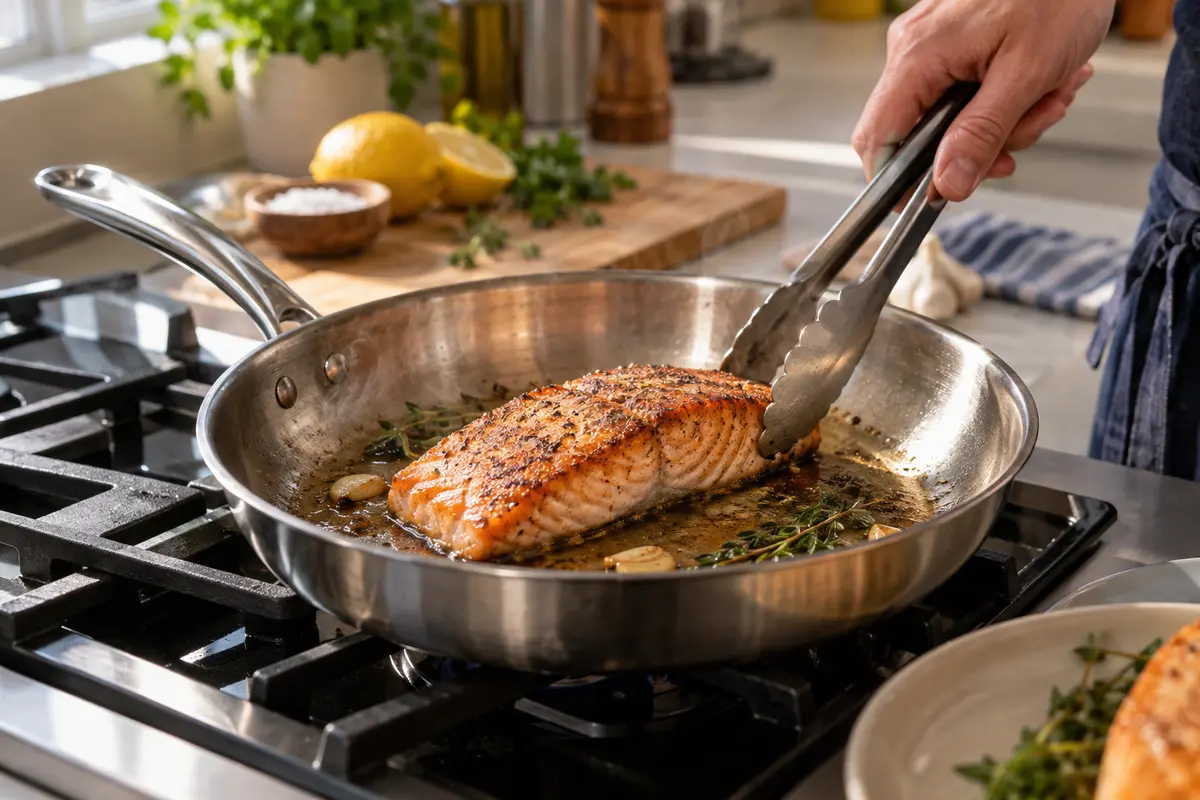
Heating: follow the core, thickness, and burner fit
A titanium-reinforced coating tells you little about the material carrying heat underneath. Likewise, a stainless steel exterior does not reveal whether a pan has a substantial conductive core or a thin base.
Compare like with like: similar diameter, similar base area, and a burner that suits the pan. A small burner under an oversized skillet can complicate even cooking. More layers and higher prices are not substitutes for useful construction information or credible testing of that specific model.
When choosing between two listings, write down cooking surface → core/body → outside base. If you cannot fill in all three, ask the manufacturer before treating a material claim as a performance advantage.
Weight and handling: compare the same size
A backpacking pot is not a fair weight comparison for a large home skillet. Titanium-bonded cookware still contains a substantial clad body.
A same-size example makes this clear: the written specification tables for Hestan’s 12.5-inch NanoBond and ProBond stainless steel skillets list weights without lids of 3.39 lb and 3.42 lb, respectively. That is only 0.03 lb apart. These are published specifications, not our measurements, and they do not establish a weight rule for other brands.
Handle angle, grip width, balance, and a helper handle can be more useful than a small difference on paper. If lifting is difficult, try holding the exact pan before buying and consider how it will feel full of food.
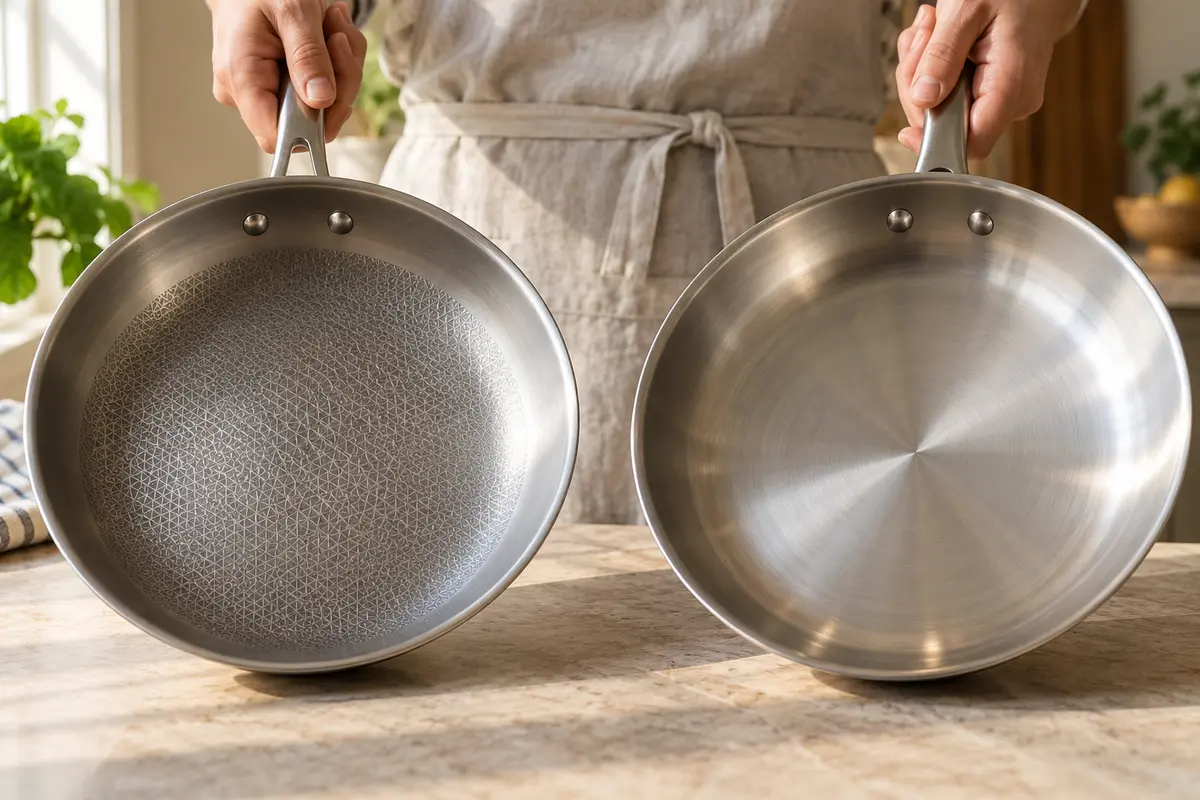
Coatings and material disclosures: what to check
A useful product listing should help you answer these questions without guessing:
- What touches the food? Look for uncoated stainless steel, solid titanium, a titanium-bonded surface, PTFE nonstick, or another clearly identified coating.
- What is underneath? Identify the body, core, and base, not just the top surface.
- Does the exact model disclose PTFE or PFAS? PFOA-free is not the same statement as PTFE-free or PFAS-free. T-fal’s disclosures demonstrate why those labels must not be treated as interchangeable.
- What are the operating limits? Check stovetop compatibility, empty-pan preheating guidance, utensil restrictions, and oven and broiler rules.
- Can you find a model-specific manual? Save it with the receipt. A collection name may cover several constructions or generations.
Descriptions such as “stone,” “diamond,” “titanium,” or “non-toxic” are not a complete ingredient list or proof that a pan suits every use. If avoiding a particular coating is your priority, require an explicit disclosure for the exact item. Our guide to PFAS-free titanium pan options is a related starting point; confirm current manufacturer information before purchasing.
Induction and oven limits vary by model
Here are concrete examples from the manufacturer pages reviewed. They are compatibility examples, not interchangeable instructions for every pan sold under these brands.
| Example | Induction | Manufacturer’s published oven guidance |
|---|---|---|
| T-fal Ultimate Hard Anodized H927SA64 | No | Pans: 400°F; lids: 350°F. |
| All-Clad D3 uncoated fry pans in the linked set | Yes | Oven and broiler: up to 600°F. |
| Hestan NanoBond skillets | Yes | Up to 1,050°F, according to Hestan. |
These are limits, not recommended cooking temperatures. Check your pan, lid, removable parts, and appliance instructions together; use the lowest applicable limit. Pure titanium itself does not supply the magnetic base required by conventional induction cooktops, although a composite titanium-surface pan can include one. Confirm the product’s compatibility and minimum base size rather than judging by appearance.
Durability, cleaning, and cost
Separate a durable pan body from a durable nonstick coating
A sturdy body can outlast its food-release coating. Titanium reinforcement does not give a nonstick pan an unlimited lifespan, and “scratch-resistant” does not mean scratchproof. T-fal notes that coating life depends on frequency of use and care rather than promising a fixed number of years.
An uncoated stainless steel pan has no conventional nonstick film to wear away, but it can still suffer from warping, pitting, loose handles, or misuse. A treated surface adds another model-specific consideration. Read what the warranty covers instead of assuming that a lifetime warranty includes ordinary wear or every loss of performance.
Build the cleaning routine around the surface
- Uncoated stainless steel: let it cool, soften residue with warm soapy water, and use a suitable sponge. For persistent stains, use only a cleaner approved for that pan.
- Titanium-reinforced nonstick: use gentle utensils and cleaning tools as directed. Avoid applying an abrasive stainless-steel cleaning routine to a coated interior.
- Titanium-bonded stainless steel: follow that collection’s cleaning guide; do not transfer its permitted cleaners or utensils to unrelated titanium-branded cookware.
- Solid titanium camping cookware: follow the maker’s guidance for the vessel and handle. Burned-on food still needs cleaning even without a nonstick layer.
All-Clad’s care guidance is a useful example of why instructions matter: it warns against thermal shock from putting a hot pan under cold water and identifies cleaners to avoid. Dishwasher suitability is also model-specific; the D3 set linked above is labeled handwash only.
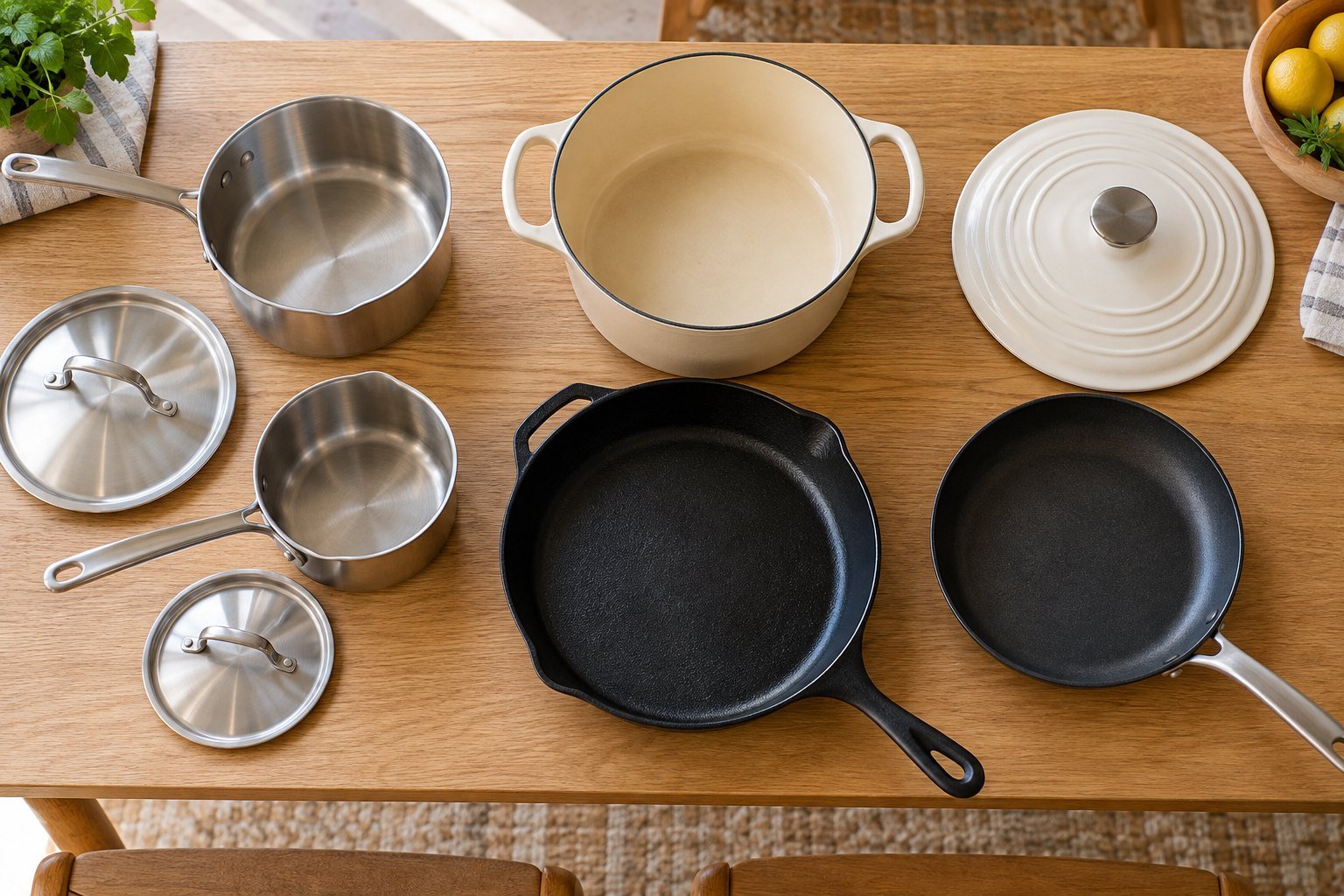
Value: pay for a feature you will use
For everyday home cooking, a well-chosen stainless steel skillet can be a practical long-term purchase. A nonstick pan can be worthwhile for a narrower job, especially if easier breakfasts matter more to you than keeping the same coating indefinitely. A premium bonded surface should solve a specific preference—not simply sound more advanced.
For scale, Hestan’s U.S. collection listings on the research date showed the 12.5-inch NanoBond skillet at $450 and the same-size ProBond stainless skillet at $250, before tax or shipping. This is a same-brand price example, not a market-wide average; promotions and prices change. Ask whether the surface treatment is worth that difference for your cooking.
You may get better value by buying one suitable skillet and one smaller egg pan than by replacing an entire set. Count the vessels you will actually use: a set’s piece count may include lids or utensils.
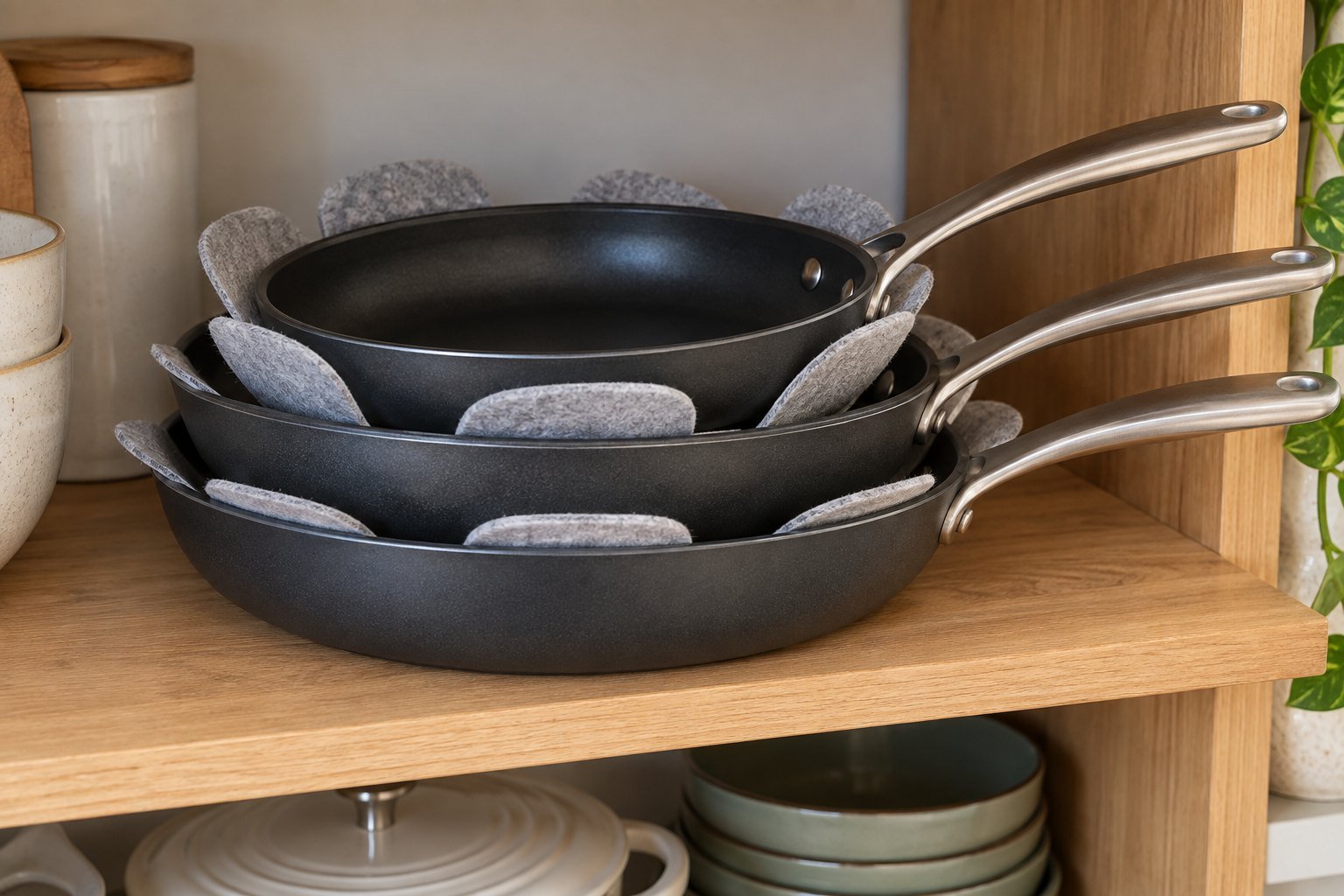
Protect coated surfaces when stacking, and give heavy pans an accessible home. See our pots and pans organization guide for practical storage layouts.
Which type suits your cooking needs?
For everyday home cooking: start with clad stainless steel
If you cook a mix of vegetables, meat, sauces, and stovetop-to-oven dishes, shortlist an uncoated clad stainless pan with a comfortable handle and suitable base size. Compare its construction and care requirements before paying for extra layers or branding. This is our practical starting recommendation, not a claim that every stainless pan performs equally.
For easy food release: buy an actual nonstick pan
If eggs or delicate foods are your main use, select a disclosed coating you are comfortable with and follow its limits. Titanium reinforcement can be one feature to compare, but it is not a reason to ignore the coating’s identity or replacement needs.
For a premium upgrade: evaluate titanium-bonded stainless
Consider this category if you already enjoy stainless-style cooking and value the particular finish, cleaning features, or manufacturer-backed surface properties. Try one useful size before committing to a full set. Expect to manage heat and use fat appropriately.
For lightweight camping: consider solid titanium
Choose a compact titanium pot when carrying less and heating water are central to the trip. If you plan to fry full meals, evaluate the actual vessel and heat distribution instead of borrowing an ultralight boiling pot’s advantages.
Frequently asked questions
Is titanium cookware nonstick?
Not automatically. Titanium-reinforced nonstick cookware has a nonstick system, but solid titanium is not inherently nonstick, and Hestan says NanoBond is not a nonstick coating. Read the interior-surface description.
Can titanium cookware contain PTFE?
Yes. Some titanium-reinforced nonstick cookware contains PTFE. A titanium label does not establish that a product is PTFE-free, and PFOA-free is a different claim.
Does titanium cookware work on induction?
Some does and some does not. Compatibility depends on the base and the cooktop’s requirements. A titanium-based cooking surface can sit above an induction-compatible base; a lightweight solid titanium pot should not be assumed compatible.
Are titanium-coated pans better than stainless steel?
“Titanium-coated” is too vague for a verdict. First establish whether it means a reinforced nonstick coating or a titanium-based surface treatment over stainless steel. Then compare the construction, food release, care, and price of the actual models.
Which is easier to clean?
A functioning nonstick surface generally makes routine food removal easier, but it requires coating-friendly care. Stainless steel may need soaking after browning. Titanium-bonded surfaces have their own instructions; do not assume every titanium-labeled pan tolerates the same cleaner.
Should I replace good stainless steel cookware with titanium?
Not just for the label. Identify a problem first: difficult food release, uncomfortable weight, unsuitable stove compatibility, or cleaning you dislike. If your existing pan already fits your meals, a different surface may not justify the expense.
Sources and how we made this comparison
We used manufacturer documentation to identify materials, operating limits, and examples of same-size specifications. Our buying advice is an editorial interpretation of those facts and the different jobs a pan needs to do. We did not measure heat distribution, weigh pans, run scratch tests, or verify manufacturer durability multipliers. Specifications can vary by market and revision; the manual supplied with your exact item takes priority.
- Snow Peak: Cookware Focus — solid titanium and its intended cooking uses.
- T-fal H927SA64 product specifications and nonstick material disclosures — coating identity and model limits.
- Hestan: preventing sticking with NanoBond — distinction from nonstick cookware.
- Hestan NanoBond skillet specifications and ProBond skillet specifications — construction and listed weights.
- NanoBond and ProBond collection listings — dated U.S. price examples.
- All-Clad D3 fry-pan specifications and care and use guidance — clad construction, cooking technique, and care limits.
Kitchen conditions and products vary. Follow manufacturer guidance and consult a qualified professional when safety or specialist work is involved.