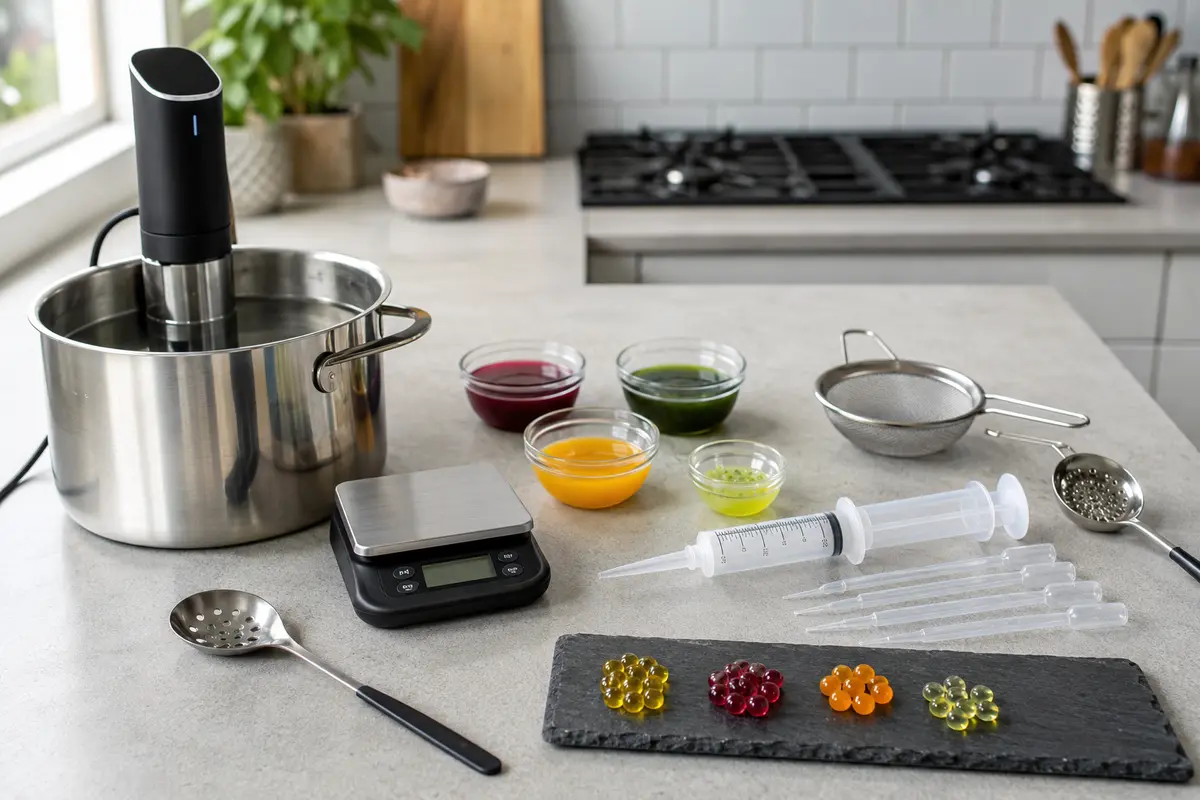
Beginners need precision more than novelty: a reliable digital scale, thermometer, immersion circulator, pipettes, fine sieve, syringe, and a reputable technique kit cover many home experiments.
Molecular gastronomy may seem intimidating at first, but with the right tools, it becomes far simpler, and any kitchen countertop becomes an arena for culinary innovation. We will examine five essential utensils for anyone wanting to master molecular gastronomy at home.
Spherification Tools
Spherification is one of the hallmark techniques in molecular gastronomy, turning liquid ingredients into delicate caviar-like balls or larger, more stable pearls. Made famous by culinary innovator Ferran Adria of ElBulli restaurant fame, this technique involves mixing liquid ingredients with sodium alginate before submerging droplets in the calcium-rich bath to form gel membranes for each droplet of mixture containing sodium alginate and submerging them again for drying out purposes to form caviar-like caviar balls/pearls/spheres/pearls/etc...
Spherification in Culinary Alchemy
Spherification tools play an essential part in creating these spheres. Their design helps manage their size, shape, and consistency in ways impossible using standard kitchen utensils; precision and consistency ensured by these tools ensure spheres have that desirable "pop" and mouth feel that is synonymous with this technique.
Benefits of Dedicated Spherification Kits
Modern spherification kits usually come with calibrated droppers, slotted spoons, and syringes, making otherwise fiddly and imprecise work a breeze. The syringes are particularly useful for depositing the droplets into the spherification bath without fuss, while the slotted spoons allow for easy retrieval. The droppers are also designed to release the liquid without applying too much pressure, which can affect the delicate shape of the spheres.
Ionizing Spray Bottle
Have you ever been curious as to how chefs add just the right touch of flavor without altering the texture or composition of their dishes? An Ionizing Spray Bottle could be your answer. Utilizing ultrasonic vibrations, this innovative tool converts liquid into mist-like particles that adhere to food surfaces without altering their properties; this process, known as Nebulization, adds bursts of flavor or aroma to food in a controlled fashion.
Versatility of the Ionizing Spray Bottle
An ionizing spray bottle can do more than add flavorings to solid foods - it is also used for creating foams and emulsions - making it an invaluable asset in molecular gastronomy. Ultrasonic vibrations produce fine mist to evenly disperse liquid, giving chefs freedom to experiment with various flavors and textures without overshadowing their dishes.
A Must-Have for Flavor Development
In traditional cooking, adding flavor is usually limited to seasoning or marinating. However, with an ionizing spray bottle, chefs can explore a whole new world of flavor development and customization. The ability to control the intensity and distribution of flavor makes this tool essential for any molecular gastronomy enthusiast.
Molecular Gastronomy Kit
For those aspiring to go beyond spherification, an all-encompassing molecular gastronomy kit is essential. Custom-tailored kits often include various chemicals like agar, carrageenan, and xanthan gum that have specific roles in creating molecular transformations, as well as tools like pipettes, silicone molds, and pH test strips, allowing one to craft intricate dishes with ease.
Experimentation with Texture
Molecular Gastronomy offers chefs an ideal platform to experiment with creating different textures within food. Kits allow chefs to easily explore and craft unique and intriguing textures by using ingredients such as gelling agents, foaming agents and thickeners; unleashing their creative minds!
Unpacking the Basics
A basic kit might feature measuring spoons, a set of molecular tools, and the aforementioned chemicals that aid in processes such as gelification, emulsification, and thickening. These can be the gateway to crafting everything from spaghetti made of liquid to foams and airs that were once the domain of laboratory equipment.
Enhancing Creativity with a Kit
Using a kit like this can open up a world of experimentation and creativity. One can adapt traditional recipes using the chemicals and tools provided or use the kit for its intended purpose, following recipes to the letter to learn the ins and outs of molecular gastronomy.
Smoking Gun
Smoking guns are a versatile addition to the molecular gastronomer's arsenal. These handheld devices turn wood chips, herbs, and spices into aromatic smoke that can be infused into food or encapsulated within containers for a smoky surprise. Smoking guns come with a variety of wood chips and other flavoring agents, allowing chefs to experiment with different flavors and intensities.
A Whiff of Flavor Innovation
Smoking guns offer one of the simplest, easiest, and most controlled ways to introduce smokey flavor into food dishes in an incremental and controlled way. When combined with an enclosed space such as a food-grade dome, capturing and infusing smoke into anything from meats and cheeses to cocktails and desserts can easily be accomplished using different wood chips that create individual flavor profiles and bring depth into dishes.
Beyond Just Smoke
The Smoking gun can also be used to infuse other aromatics, such as dried herbs and spices, into dishes. This allows for a more delicate infusion of flavors without having to use heat or add liquid ingredients. The precision and control offered by this tool make it a favorite among molecular gastronomy enthusiasts.
Tips for Effective Smoking
To optimize the benefits of your smoking gun, ensure your food is at an appropriate temperature - typically cool or room temperature--so as to absorb as much smoke as possible. Also, try different fuels, like wood chips and dried herbs, for an array of flavors not achieved using traditional smoking techniques.
Sous Vide Precision Cooker
Sous vide (French for "under vacuum") refers to a technique for cooking food using an water bath heated at precisely controlled temperatures, used frequently in molecular gastronomy as it allows precise control over its environment, yielding soft and juicy results every time. Nowadays thanks to modern precision cookers like those featured here, sous vide cooking techniques have become accessible cooking methods available to everyone.
The Magic of Sous Vide
Sous Vide dispositions have revolutionized home cooking for everyone from scientific enthusiasts to those simply wanting an effortless way of producing restaurant-grade results with little effort required. Popular among meat and fish chefs alike, sous vide precision cookers offer an effortless method of perfecting meals every time without overcooking or burning ingredients, creating restaurant quality results with minimum effort required.
Incorporating Sous Vide Into Your Kitchen
Make the most out of your sous vide equipment to maximize results: ensure ingredients are vacuum sealed properly and monitor cooking times meticulously, monitoring every second for consistency in color retention among veggies while tenderizing tough cuts of meat to gelatinous consistency and vegetables keeping their vibrant hues. A sous vide precision cooker should be an invaluable asset when looking to elevate their dishes through molecular gastronomy.
Culinary Syringe Set
Our final must-have on our must-have list is the culinary syringe set, an invaluable precision tool. Perfect for injecting flavors into Thanksgiving turkey or adding small touches like a garnish, it allows chefs to precisely add minute amounts of liquid or puree without altering the texture of dishes. With various needle sizes and materials to choose from, chefs have access to add just what their recipe calls for without the risk of overkill!
Precision Meets Practicality
Precision can often make all the difference when it comes to molecular gastronomy. A culinary syringe provides precise measurements, guaranteeing flavors are distributed exactly where desired - this level of control is especially valuable in creating molecular cocktails or intricate pastry decorations.
Presentation and Flavor Infusion
Culinary syringes can also provide an invaluable aid in presentation. By artfully injecting sauces or purees into dishes, culinary syringes allow for creative flavor combinations with visual interest that showcase your culinary prowess and skill. From deconstructed dishes to multi-component entrees, a syringe set can truly change how they're prepared!
Conclusion: Mastering Molecular Gastronomy at Home
Molecular gastronomy's beauty lies in its capacity to transform familiar ingredients and flavors into something entirely novel using imaginative techniques. While exploring this area can seem intimidating at first, equipping your kitchen with tools such as spherification tools, molecular gastronomy kits, smoking guns, sous vide precision cookers, and culinary syringe sets makes the entire process enjoyable and approachable - and won't just become another gadget to purchase; rather it provides invaluable culinary training that expands understanding and enjoyment of food beyond.
Molecular Gastronomy offers home chefs culinary adventure in its pursuit. These five tools go far beyond being mere kitchen objects; they open doors into a world where scientist meets chefs in delicious combinations, where traditional recipes become variables thanks to experimentation, and where constants become variables thanks to creativity in the preparation of dishes and menu planning. If there's any advice here, it would be simply this - begin small: get acquainted with one tool before moving on to others - you won't look back once your guests appreciate your culinary endeavors have begun! Happy Gastronomic adventures!
Frequently asked questions
What should a beginner buy for molecular gastronomy?
A digital scale, accurate thermometer, pipettes or syringe, fine sieve, immersion blender, and one reputable food-grade kit are a practical start.
Is molecular gastronomy safe at home?
It can be when food-grade ingredients, precise measurements, tested recipes, hygiene, and normal food-safety rules are used. Do not improvise with laboratory or industrial chemicals.
Do I need a smoking gun or sous vide machine?
No. Choose equipment for the technique you want to practice. Spherification and gels can be learned without either device.
Kitchen conditions and products vary. Follow manufacturer guidance and consult a qualified professional when safety or specialist work is involved.