A sharp knife is easier to control than a dull one, but sharpening requires a stable surface, a consistent angle, and careful hand placement. Work slowly and stop if the stone or sharpener moves.
Sharpening versus honing
Sharpening removes a small amount of metal to form a new edge. Honing mainly realigns or refines an edge between sharpenings. A honing rod cannot repair a rounded, chipped, or badly worn bevel.
Choose a suitable method
Whetstones offer control and can produce an excellent edge, but they take practice. Guided systems help maintain an angle. Manual pull-through sharpeners are fast, although fixed slots may remove more metal and may not suit every blade. Use professional service for valuable, serrated, single-bevel, or damaged knives when you are unsure.
How to sharpen with a whetstone
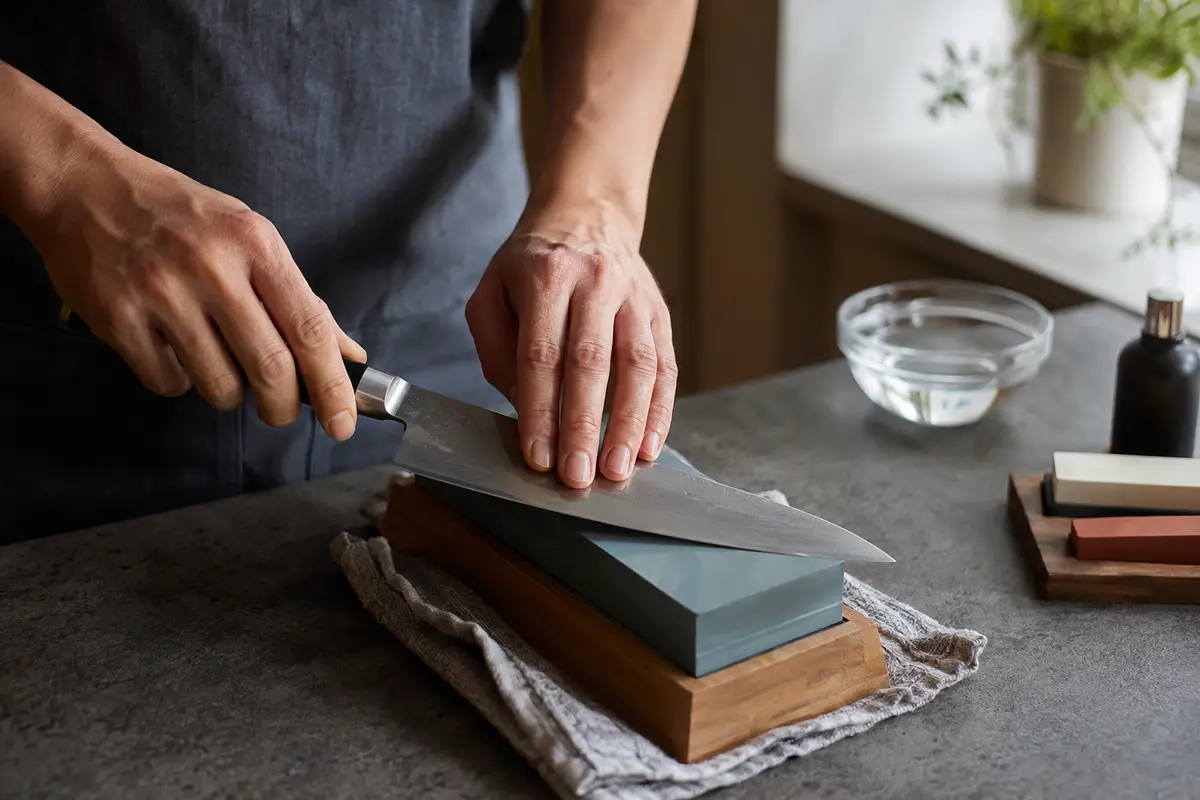
- Check the instructions. Soak only stones that require soaking and place the stone on a nonslip base.
- Use the correct angle. Follow the knife maker's recommendation; many Western kitchen knives fall around 15 to 20 degrees per side.
- Make controlled passes. Move the edge across the stone while keeping fingertips behind and above the cutting edge. Work both sides evenly.
- Raise and remove the burr. A small burr indicates the bevel has reached the edge. Use lighter alternating passes on a finer stone to refine and remove it.
- Clean and dry. Rinse away residue as the manufacturer permits, dry the knife immediately, and flatten or maintain the stone as required.
Using a manual or guided sharpener
Stabilize the sharpener on a counter, use the slot intended for the knife, and pull the blade through with light even pressure. Do not force the blade or run it back and forth unless the instructions specifically say to. Ceramic finishing slots need fewer, lighter passes than coarse repair slots.
Test the edge safely
Use a sheet of paper, a ripe tomato, or another controlled food test. The blade should cut cleanly without heavy pressure or tearing. Never slide a finger along the edge, and do not test by catching a falling knife.
Common mistakes to avoid
- Changing the angle during each stroke
- Using excessive pressure or too many coarse passes
- Sharpening serrated knives in a standard pull-through slot
- Allowing the stone or board to move
- Leaving water or metal residue on a carbon-steel blade
- Trying to grind out a large chip without the right equipment
Keep the knife sharp longer
Use wood or suitable plastic cutting boards rather than glass, ceramic, or stone. Wash and dry knives by hand unless the maker allows a dishwasher, store the edge in a sheath, block, insert, or secure magnetic strip, and hone only with a tool compatible with the blade.
Frequently asked questions
What angle should a kitchen knife be sharpened at?
Many Western kitchen knives use roughly 15 to 20 degrees per side, but the manufacturer's recommendation should take priority.
Should a whetstone be soaked?
Some water stones need soaking while splash-and-go stones do not. Follow the stone maker's instructions to avoid damage.
How do I know when a knife is sharp?
A sharp edge should slice cleanly through paper or a ripe tomato with little pressure. Never run a fingertip along the edge.
Kitchen conditions and products vary. Follow manufacturer guidance and consult a qualified professional when safety or specialist work is involved.